



An email marketing strategy is your plan for using email to move people from where they are now to where you want them to be. For an e-commerce store, that might mean moving a first-time browser to a repeat buyer. For a SaaS company, it might mean moving a free trial user to a paid subscriber.
In this article, we'll show you how to build an email marketing strategy that actually works as a system and not just a collection of one-off sends you're making up as you go.
We'll walk through the core components every strategy needs, from list building and behavioral segmentation to automation flows and deliverability setup, and explain what each piece is really supposed to do for your business.
Let's understand what makes an email strategy worth adopting.
What is a Good Email Marketing Strategy?
The "strategy" part is the system you build to make that movement happen. It defines who you're targeting, what sequence of messages they get, what each message is trying to accomplish, and how you measure whether it's working. Everything else (the subject lines, the design, the send times) is execution that lives inside that system.
There's also no single version of a good email strategy. A good strategy for you is the one that matches your business model.
For example, an e-commerce brand might send three to four promotional emails a week because that's what drives revenue, and their subscribers expect it. A B2B SaaS company doing the same thing would torch their list in a month. Their strategy leans heavily on educational newsletters, product updates, and drip sequences that nurture leads over weeks or months.
Most guides define strategy as "segment your list, write good subject lines, test your CTAs." That's not a strategy. That's execution. Strategy sits one level above: it's the set of decisions that determine who you email, why you email them, what you say, and how often you show up in their inbox.
Here's what separates a basic email strategy from a good one:
It starts with a clear goal per email type: A welcome sequence has a different job than a re-engagement campaign. A good strategy doesn't treat every send the same. Your welcome email's job might be to get a second click. Your nurture sequence's job might be to surface a pain point. Your promo email's job is conversion. When every email has a defined purpose, you stop writing "just checking in" emails that no one asked for.
It respects the subscriber's context: Someone who signed up yesterday and someone who's been on your list for two years are in completely different headspaces. A good strategy accounts for where people are in their journey. This means your automation logic matters as much as your copy.
It treats deliverability as a prerequisite, not an afterthought: None of your strategy matters if your emails land in spam. List hygiene, authentication (SPF, DKIM, DMARC), consistent sending patterns, and engaged-subscriber targeting aren't "advanced" tactics. They're the foundation everything else sits on.
It has a feedback loop built in: You're not just sending emails and hoping. You're tracking opens and clicks, yes, but you're also watching unsubscribe reasons, reply rates, and revenue per email. A good strategy evolves because the data tells you what to change and not because a blog post told you to "try emojis in subject lines."
A good email marketing strategy makes your next 100 emails easier to write, not harder. If every send feels like you're starting from scratch, you don't have a strategy yet.
What Are the Key Components of an Email Marketing Strategy?
Every email marketing strategy is built on the same set of core components. The industry changes, the tools change, the audience changes, but these building blocks stay constant. Here's what you need to get right.
1. A Subscriber List You Actually Own
Your email list is the only marketing asset that doesn't depend on a third-party algorithm. Your Instagram reach can drop tomorrow. Google can change its ranking rules overnight. But your email list stays with you as long as you maintain it.
The emphasis here is on maintain. A list isn't just a number. It's a group of people who raised their hand and said they want to hear from you. That distinction matters because how you build the list determines how well everything else in your strategy performs.
A few things that define a healthy list:
Every subscriber opted in with a clear understanding of what they'd receive. No pre-checked boxes, no vague "stay updated" promises.
You're removing hard bounces, inactive addresses, and spam traps on a regular basis, and not once a year when deliverability tanks.
Growth is steady and organic, not driven by purchased lists or giveaway signups who only wanted the free thing.
2. Segmentation That Goes Beyond Demographics
Most email platforms let you segment by name, location, age, or gender. That's table stakes. The segmentation that actually moves the needle is behavioral.
Here's the difference:
Demographic segment: Women aged 25–34 in California.
Behavioral segment: Subscribers who opened three or more emails in the last 30 days, clicked on a product page, but haven't purchased yet.
The first group shares a profile. The second group shares an intent signal. You can write a much more targeted email to the second group because you know where they are in the decision-making process.
Behavioral segments worth building early:
New subscribers (joined in the last 7–14 days)
Highly engaged (opening and clicking consistently)
Bought once but never returned
Active browsers who haven't converted
Gone quiet (no opens in 60–90 days)
Start with these, and you'll already be ahead of most senders who blast the same email to their entire list.
3. A Defined Email Mix
You need to decide what types of emails you're going to send and what role each type plays. Without this, you end up sending whatever feels urgent that week, which usually means too many promotions and not enough value.
Most strategies pull from some combination of these:
Welcome sequences: The first emails a new subscriber receives. These set the tone for the entire relationship and typically see the highest open rates you'll ever get.
Nurture sequences: Ongoing emails that build trust, educate, and move people closer to a decision without hard-selling.
Promotional emails: Direct offers, launches, sales, and time-sensitive campaigns designed to drive a specific action.
Transactional emails: Order confirmations, shipping updates, password resets. These are functional, but they're also brand touchpoints that most companies underutilize.
Re-engagement campaigns: Targeted emails to subscribers who've stopped interacting, with the goal of either winning them back or cleaning them off the list.
The ratio between these depends entirely on your business model. An e-commerce store might run 60% promotional and 20% transactional. A B2B SaaS company might flip that to 50% nurture and 30% educational content. A solo consultant might send one weekly newsletter and nothing else.
The important thing is that the ratio is a conscious decision, not something that happened by default.
4. Automation That Does the Heavy Lifting
If every email you send requires someone to sit down, write it, pick the audience, and hit send, your strategy has a scalability problem. Automation handles the emails that should run in the background without manual intervention.
The automations most strategies need on day one:
Welcome flow. Triggers the moment someone subscribes. Usually 3–5 emails over a week or two.
Abandoned cart or abandoned browse. For e-commerce, this alone can recover a meaningful percentage of lost revenue.
Post-purchase follow-up. A thank-you email, a review request, or a cross-sell recommendation timed after delivery.
Re-engagement trigger. Fires after a subscriber goes inactive for a set period (say, 60 days or 90 days).
Once these four are running, you've automated the most high-impact touchpoints in the customer journey. Everything you build after that, such as birthday emails, milestone triggers, and upsell sequences, can be layered on top of this foundation.
5. Deliverability Infrastructure
Deliverability is the least exciting part of email marketing and also the part that can quietly destroy everything else. You can write brilliant emails, segment perfectly, and automate flawlessly. But if your emails land in spam folders, none of it reaches your audience.
Deliverability depends on a few technical and behavioral factors working together:
Authentication protocols. SPF, DKIM, and DMARC need to be configured correctly. These tell inbox providers that your emails are legitimate and haven't been spoofed.
Sender reputation. This is a score that inbox providers assign based on your sending behavior — bounce rates, spam complaints, engagement levels. It builds over time and can drop fast if you make mistakes.
List hygiene. Regularly removing invalid addresses, role-based emails, and long-term inactive subscribers keeps your bounce rate low and your engagement metrics healthy.
Consistent sending patterns. Sending 500 emails a week and then suddenly blasting 50,000 is a red flag for spam filters. Gradual, consistent volume is what builds trust with inbox providers.
If you're just getting started, set up authentication first. It takes an afternoon, and it's the single highest-impact deliverability action you can take.
6. A Measurement Framework
Knowing what to measure and when to measure it is what turns email marketing from guesswork into a system you can improve over time. The goal is to connect your email metrics to actual business outcomes so you can tell which emails are earning their place and which ones need to change.
Different metrics tell you different things:
Open rate tells you whether your subject line and sender name earned attention.
Click-through rate tells you whether your content and CTA were compelling enough to drive action.
Conversion rate tells you whether the email moved someone to do what you actually wanted
Unsubscribe rate and spam complaints tell you whether you're sending too often, to the wrong people, or with content that doesn't match expectations.
List growth rate tells you whether your acquisition channels are healthy or stalling.
Revenue per email (for e-commerce and direct-response) tells you the actual monetary value of each send.
The key is to decide upfront which metrics matter most for each type of email. A welcome sequence should be measured on click-through and conversion, not revenue. A flash sale email should be measured on revenue, not open rate. Matching the right metric to the right email type prevents you from optimizing for vanity numbers that don't reflect real performance.
Put Your Strategy Into Action with SendX
Everything we've covered (the segmentation, the automation flows, the deliverability groundwork, the measurement framework, etc.) only works if your email platform doesn't get in the way. That's where SendX comes in.
SendX gives you unlimited email sends with no per-email fees or daily caps, so you're never forced to choose between sending the right email and watching your bill. Its AI-powered sending engine handles the deliverability side for you. We help you monitor your sender reputation, adjust throttling in real time, and catch inbox placement issues before they snowball into a problem.
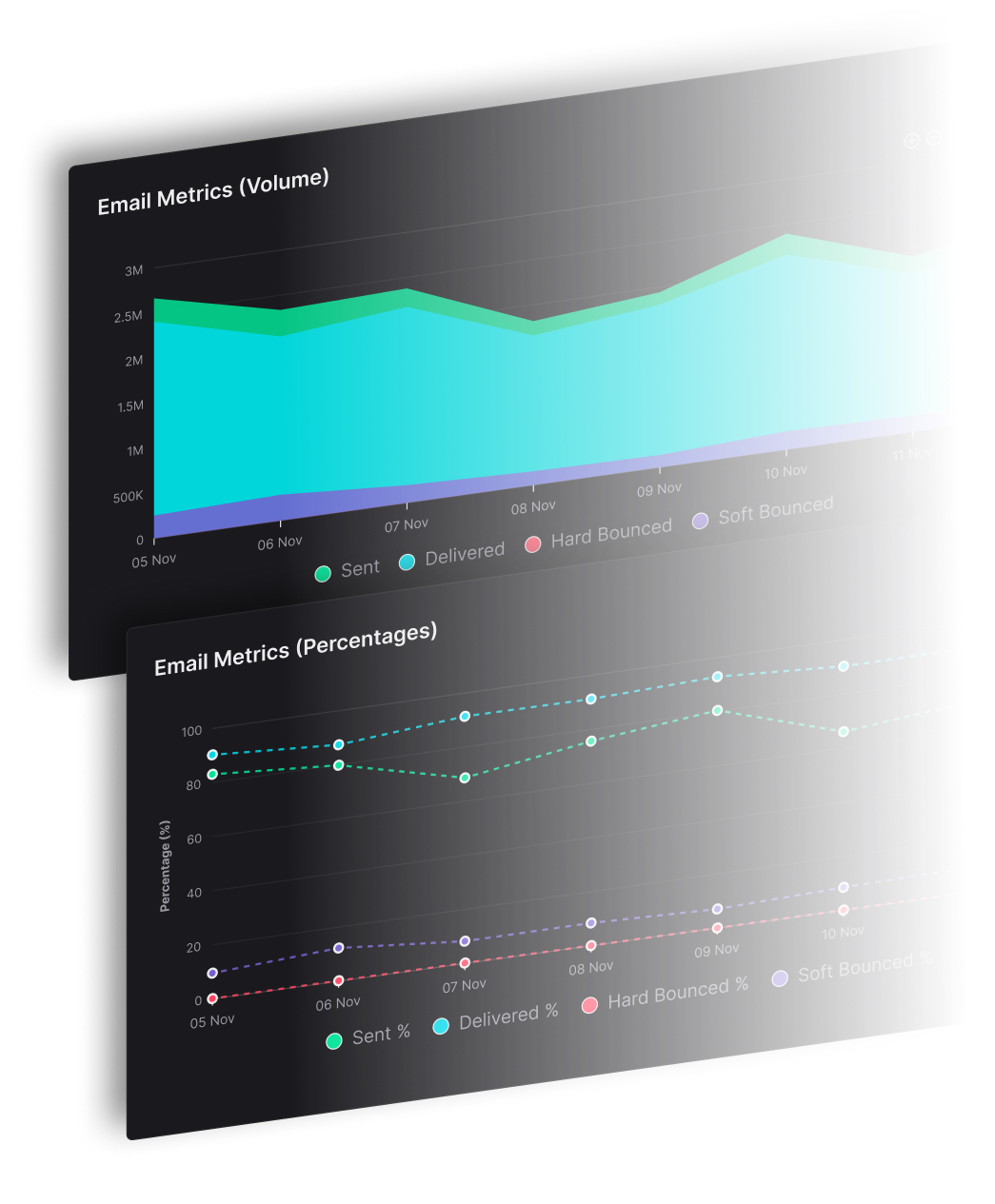
You get visual automation workflows for building those welcome sequences, abandoned cart flows, and re-engagement triggers we talked about. Behavioral segmentation is built in, so you can target based on what subscribers actually do, not just who they are. And the analytics give you the metrics that matter — opens, clicks, conversions, and revenue — without burying you in dashboards you'll never check.
Whether you're sending your first welcome sequence or scaling to hundreds of thousands of subscribers, SendX is built to grow with your strategy, not against it.
Try SendX free for 14 days . No credit card is required.
