

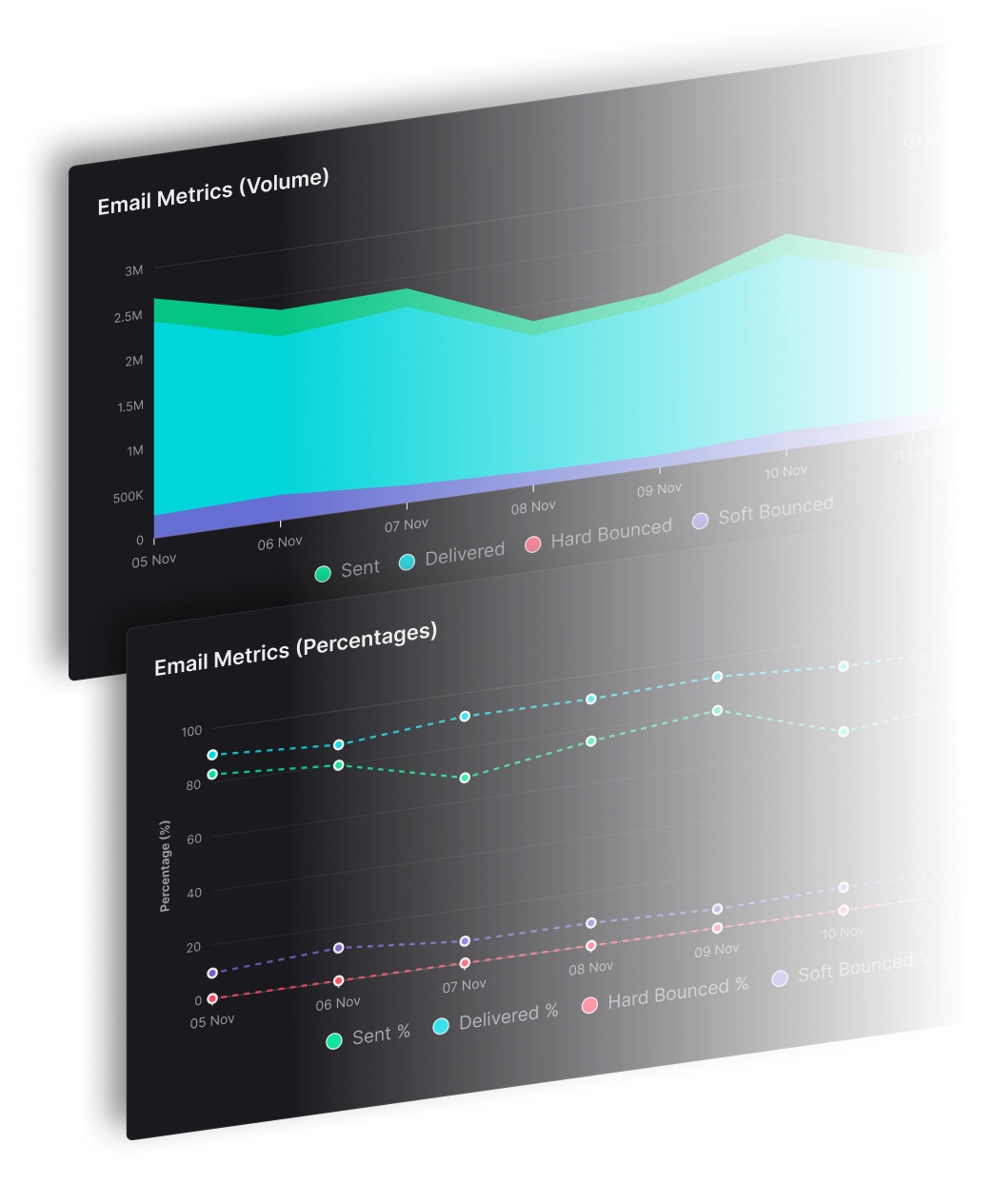


Would a bulk email service still protect your delivery reputation if every brand shares the same sending pool?
A bulk email service provides managed infrastructure for sending high volumes of email. For publishers, agencies and businesses sending on behalf of multiple users, shared infrastructure can turn one brand's delivery problem into a portfolio-wide risk.
SendX Infrastructure serves established, multi-identity senders. Account separation matters because a boundary only protects a brand if it also limits the impact of problems elsewhere in the sending pool.
What a Bulk Email Service Does for High-Volume Sending
A bulk email service coordinates message preparation, transmission, and delivery records across large sends. Like a freight carrier, it must account for different receiving rules and track each delivery outcome.
Operational work includes authentication, pacing, bounce handling, and reporting. Authentication verifies the sending identity; pacing controls how quickly messages reach a mailbox provider. Neither gives permission to contact a recipient.
The audience is substantial. The Radicati Group projected approximately 4.481 billion email users worldwide in 2024, rising to a projected 4.970 billion by 2028. For established senders, the practical challenge is reaching the intended audience consistently.
What Is a Bulk Email Sender?
A bulk email sender is the account and sending infrastructure that transmits messages. It holds the sending identity, credentials, and routing configuration.
A publisher may manage several sending identities through one software environment. Each identity can have its own domain, credentials, or IP pool, depending on how the service is configured.
Is Mass Email Software the Same Thing?
Mass email software is the campaign workspace. Sending infrastructure transmits the messages after the team prepares them and selects recipients.
Campaign evaluation should cover templates, mobile previews, personalization, segmentation, and automation. Infrastructure evaluation should cover the SMTP service for transmitting email and its controls after message submission.
Teams mapping campaign software, contact records, and delivery infrastructure can consult Verbatim Digital's martech stack overview for broader organizational context. The purchasing decision should identify who owns each failure and what records that team can inspect.
Which Bulk Email Service Fits Your Sending Scale?
| Service category | Account separation | Deliverability controls | Best-fit sending operation |
|---|---|---|---|
| Managed multi-identity infrastructure | Brand-level subaccounts, credentials, domains and pools | Brand-level reporting and mailbox-provider pacing | Publishers, agencies and software businesses sending for others |
| Campaign-led software | Confirm whether workspaces also separate sending resources | Confirm whether campaign pacing can change independently | Marketing teams prioritizing message creation and automation |
| Developer-managed sending infrastructure | Engineering team designs identity and account boundaries | Engineering team builds monitoring, routing and incident response | Businesses prepared to own delivery operations |
| Transactional-focused sending | Confirm whether message categories share reputation resources | Confirm queue priority and failure handling | Businesses prioritizing receipts and account messages |
Choose the operating model before comparing send allowances. These categories describe purchasing responsibilities, not guaranteed features. Each contract should identify the controls included.
A monthly allowance doesn't establish whether a service can handle the busiest sending window. A retailer's receipts might arrive throughout the day, while a publisher's scheduled edition creates a concentrated queue.
How Should Sending Scale Be Tested?
A useful capacity test reproduces the intended workload. It includes the normal campaign window, time-sensitive messages and the behavior of deferred mail.
A deferral is a temporary refusal by the receiving server. The sending service should queue the message and retry according to its policy, without letting delayed marketing email crowd out account messages.
- Test the queue. Confirm what happens when a campaign and transactional messages arrive together.
- Test the failure path. Inspect retry records and the final failure event.
- Test the reporting. Confirm that delayed traffic remains attributable to its sending identity.
When Should Account Separation Come First?
A publisher running several titles should prioritize separation before maximum throughput. A larger queue won't protect an established title from another title's complaints when both use the same sending resources.
Deliverability controls should also be independently adjustable. For example, a new publication might need slower sending to a particular mailbox provider while another publication continues its established schedule.
Buy capacity for the busiest sending window, but buy control for the smallest identity that might need to be paused.
Integration fit and support complete the comparison. A service that requires substantial custom operations work should be evaluated as an engineering commitment, not just an email bill.
What Volume Triggers Mailbox Provider Bulk Sender Rules?
Google treats senders delivering approximately 5,000 or more messages a day to personal Gmail accounts as bulk senders, and its bulk sender guidelines count messages from the same primary domain together. The primary domain is the registered domain under which related sending subdomains operate.
That counting rule matters more than the number of accounts inside the sending software. Separating campaigns into different workspaces doesn't necessarily separate their domain-level obligations.
Mailbox provider requirements for bulk sending to personal Gmail accounts
| Requirement | What is expected | Why it matters for multi-brand senders |
|---|---|---|
| SPF and DKIM authentication | Configure both authentication methods | Each sending identity needs correct authorization and signing |
| DMARC record | Publish a policy for the sending domain | Domain policy can't be assumed from an account setting |
| From domain alignment | Align the visible From domain with SPF or DKIM | A recognizable display name doesn't establish domain alignment |
| Easy unsubscribe | Provide an easy mechanism for promotional bulk messages | Preference changes must reach the actual sending path |
| Wanted messages | Avoid unwanted or unsolicited mail | Recipient behavior can expose problems within a particular brand |
Sources: Google's bulk sender guidelines linked above.
What Does Each Requirement Change Operationally?
Authentication records authorize infrastructure and support message verification. The sender configures the domain records, the sending software applies the relevant identity, and the receiving mailbox provider checks the result.
Alignment connects the domain recipients see in the From address with a domain validated during authentication. A message can pass an individual authentication check without establishing that connection.
Unsubscribe handling needs the same operational attention. A link that changes a campaign list but leaves another sending route active doesn't provide dependable recipient control.
What Should the Sending Team Check?
The weekly report should group traffic by primary domain, not just by campaign owner. Alerts should give the team time to investigate rising volume before a domain reaches bulk-sender scale.
Below the bulk threshold, Google still has requirements for all senders. Smaller volume isn't a reason to omit identity checks or recipient controls.
For implementation context, the Gmail bulk sender requirements guide helps connect domain configuration with day-to-day sending responsibilities.
Which Deliverability Controls Move Inbox Placement?
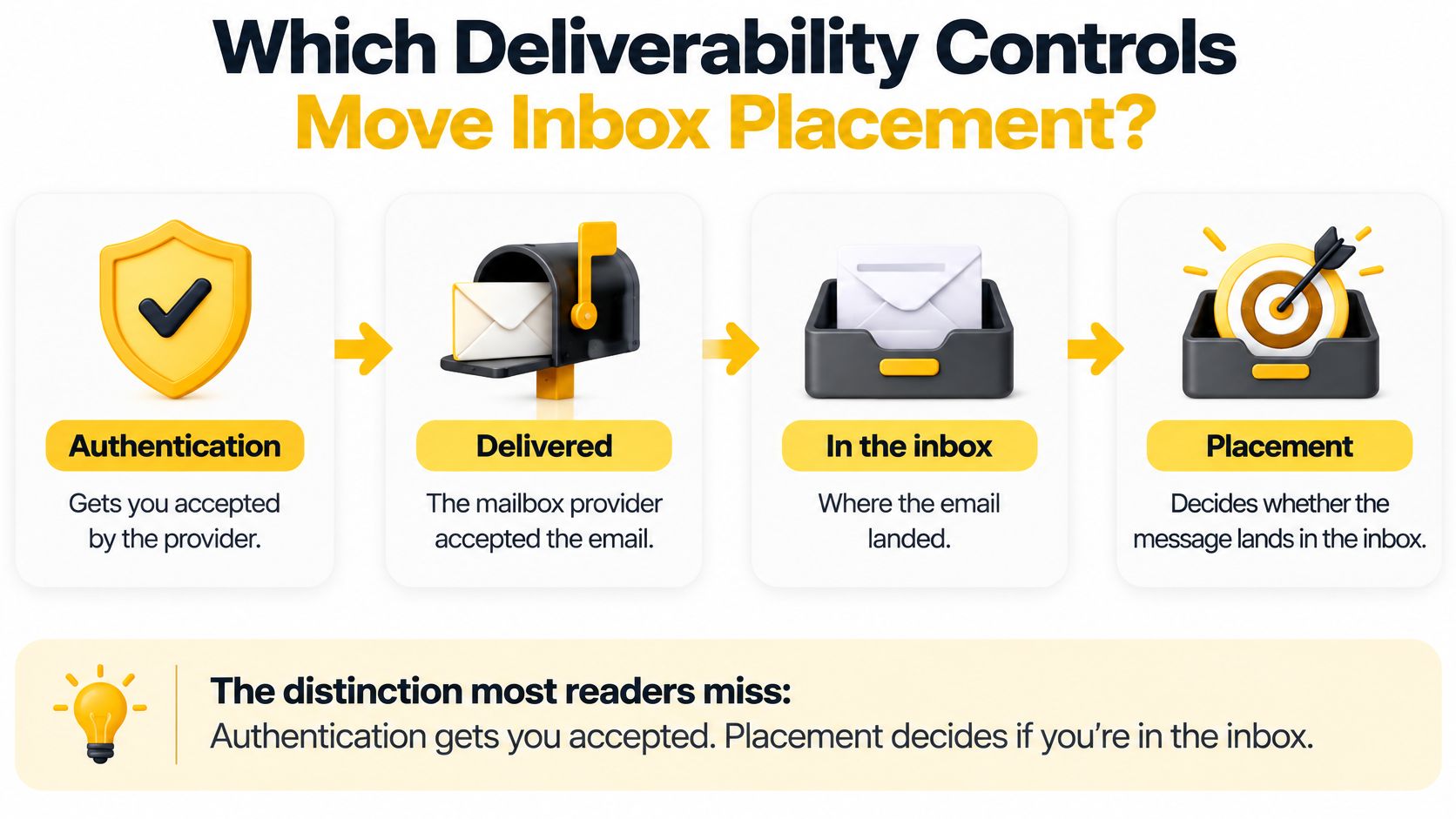
A delivery percentage measures acceptance; inbox placement requires separate evidence. Track each checkpoint in the delivery journey to see where performance changes.
What Does Authentication Establish?
SPF identifies authorized sending addresses. DKIM adds a verifiable digital signature, and DMARC checks alignment with the visible From domain and sets a policy for authentication failures. Together, these controls verify sender identity and specify how receiving systems should handle failures. They do not measure audience interest.
The FTC's email authentication explanation describes these complementary roles. A DMARC policy of p=none requests no specific handling and can support monitoring. p=quarantine requests suspicious treatment, while p=reject requests rejection. Receiving systems make the final handling decisions.
Why Should Placement Be Measured by Mailbox Provider?
Inbox placement by mailbox provider, 2024
| Mailbox provider | Inbox placement, 2024 | Other reported signal |
|---|---|---|
| Gmail | 87.2% | No additional outcome shown here |
| Yahoo/AOL | 86.0% | No additional outcome shown here |
| Apple | 76.3% | No additional outcome shown here |
| Microsoft | 75.6% | 14.6% spam rate and 9.8% missing rate |
Sources: Validity's 2025 benchmark, reporting 2024 results, also states that Gmail represented 48.5% of the mailbox sample.
These figures are benchmark observations, not a promise of results from any sending service. The differences by provider show why aggregate delivery reports can conceal placement problems.
Use the email delivery rate explanation to distinguish accepted mail from inbox placement evidence in reporting.
Which Controls Deserve Priority?
Mailbox-provider throttling adjusts sending speed for each receiving destination. If a provider defers mail from a new brand, send smaller batches there while established traffic continues to destinations accepting it.
Track these signals together:
- Placement evidence. Compare inbox tests with production delivery records.
- Complaint signals. Review available recipient complaints by sending identity.
- Deferral categories. Separate temporary rate limits from authentication or policy problems.
- Domain and IP results. Check whether an issue follows an identity, a pool or a destination.
Review list quality and content expectations, too. Authentication cannot make an outdated list welcome your messages. A misleading subject line can prompt complaints.
How Do You Keep One Brand From Hurting Another?
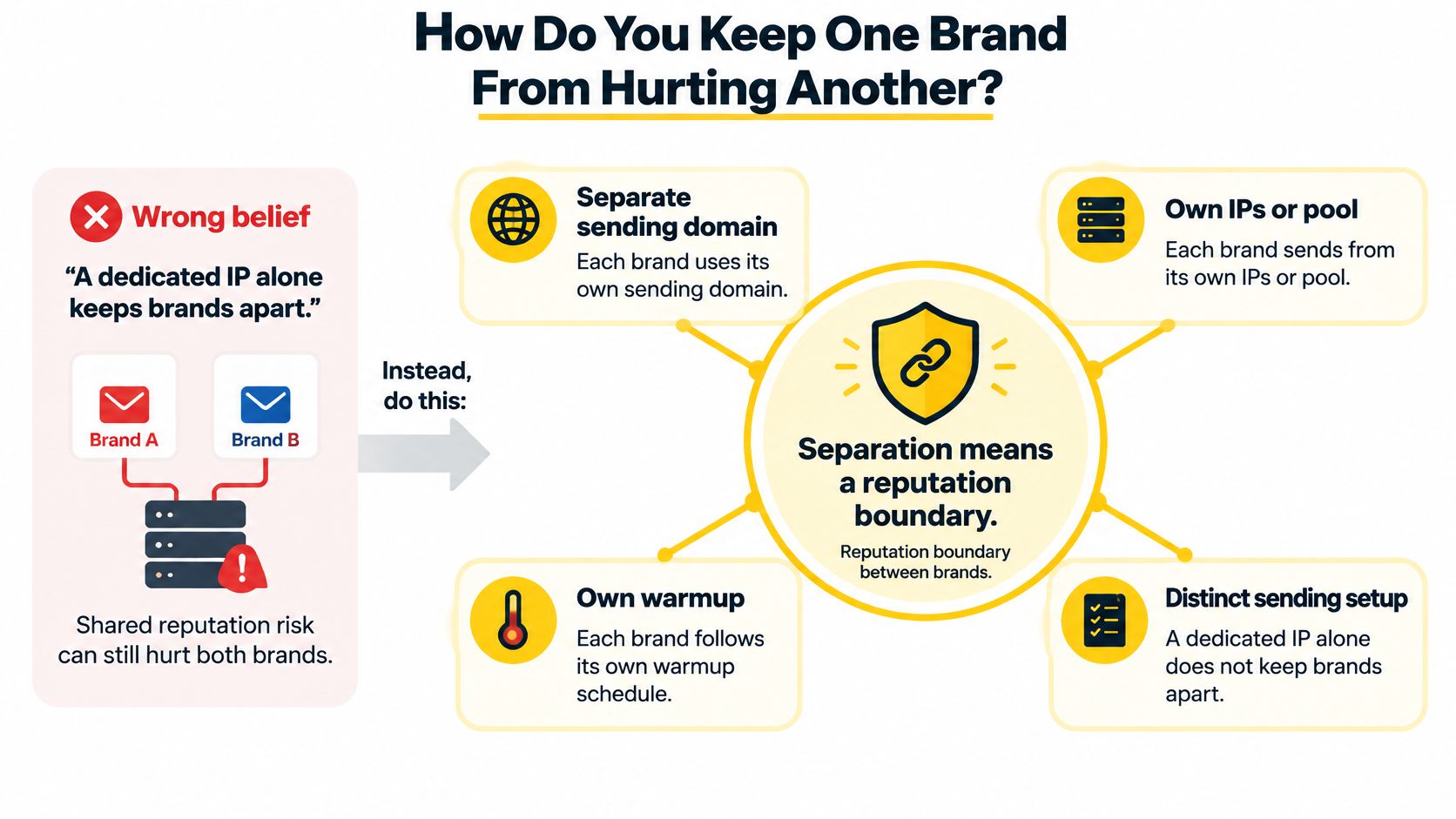
A reputation boundary keeps one brand's sending problems from spreading across an organization. A dedicated IP is one part of brand separation; the sending identity and reporting must also be separate.
Consider a publication whose title starts drawing complaints. If several titles share an IP pool, the complaint pattern can affect the pool's reputation and put the other titles' placement at risk. Separate resources reduce that connection, though mailbox providers may assess other relationships between senders.
What Should a Brand Boundary Include?
Give each brand its own sending identity, domains, credentials and assigned IP pool. Confirm whether the IPs are exclusive to that brand or shared with other senders.
Domain policy belongs in that review. The FTC's email authentication staff perspective explains the role of domain-level authentication policy.
For organizations managing several brands under distinct identities, white-label email marketing can separate the customer-facing experience. Separate branding in an interface does not establish separate delivery resources.
Before signing, verify:
- Domain ownership. Record the sending identity used by each brand.
- Pool assignment. Identify which senders share each relevant IP.
- Independent pacing. Confirm that changing one brand's sending speed does not affect another's.
- Report boundaries. Require results attributable to the brand, so a complaint or placement issue can be traced to its source.
How Should a Brand Be Tested on a New Route?
Treat the move as a controlled transition. Preserve evidence from the existing route and keep a fallback available.
- Authenticate the brand's domain and verify alignment before sending to production audiences.
- Synchronize opt-outs and permanent failures before choosing the test audience.
- Start with engaged recipients and conservative pacing for each destination.
- Compare placement, complaints and deferrals with the existing route.
- Expand only after results hold. Set clear conditions for switching back.
SendX Infrastructure supports multi-identity sending with separately managed sending resources for organizations that need to move one brand without treating every brand as a single reputation.
What Should You Verify About Opt-Outs, Integrations and Support?
An opt-out must remain in force across future campaigns and sending routes. The FTC's CAN-SPAM Act compliance guide says the opt-out mechanism must work for at least 30 days after sending, and requests must be fulfilled within 10 business days.
A suppression is a stored instruction that prevents further sends to an address within a defined scope. Like a stop order at dispatch, it must reach every applicable route.
What Should Suppression Testing Prove?
Document whether an opt-out applies to a publication, a sender or the whole organization, and define how each request affects future marketing.
- Scope. Confirm which lists, subaccounts and message categories the request affects.
- Synchronization. Test the delay between submitting an opt-out and blocking the next send.
- Continuity. Preserve applicable suppressions when a brand changes sending routes.
Good email list management preserves consent history and handles permanent failures. Reimporting an address must not erase a previous instruction.
Which Integration Details Matter?
A REST email API lets software submit messages through web requests. An SMTP relay accepts messages through the standard email transmission protocol. Choose the method that fits the existing sending workflow and the event handling the system requires.
A webhook sends event notifications to another system. Test event authentication, duplicate-event handling and whether each event is associated with its originating message.
Software development kits can reduce implementation work. Test failed requests and retries as well.
What Should Support Commit To?
Put suppression scope, integration fit and response commitments in writing. The agreement should also identify who owns escalation through resolution.
The service commitment is a first response within three hours on a work day, with email experts handling support. That gives an established sending team a defined response expectation.
Does SendX Infrastructure Fit Multi-Brand Sending?
Does each brand have a clear reputation boundary, or can one sender's problems spill over to others? SendX Infrastructure is designed for organizations sending across multiple brands, clients, or publications, where email is central to the business and reputation needs active management.
For publishers, agencies, and software businesses sending on behalf of users, the fit depends on whether the team needs managed sending infrastructure alongside its existing front end. SendX Infrastructure provides the delivery engine; SendX Marketing is a separate product for campaigns and automation.
What Changes During an Investigation?
A useful investigation connects a delivery problem to the affected identity and destination. If inbox placement falls while delivery rates look healthy, the team needs enough visibility to identify which brand is affected and where the problem appears.
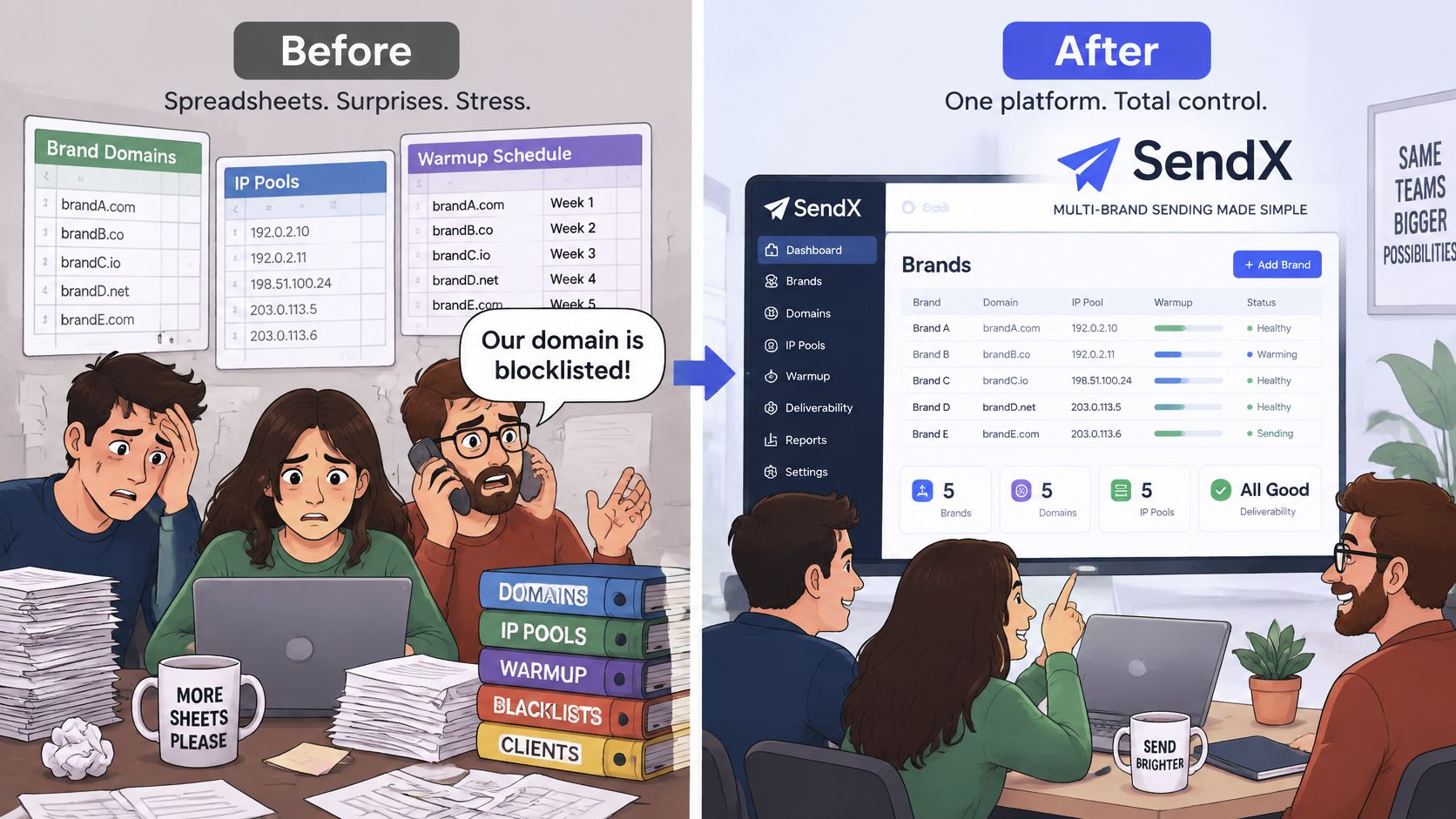
That visibility matters because a shared sending pool can make one brand's incident a risk for others. Infrastructure built for multi-identity sending should make reputation boundaries part of the operating model, not a spreadsheet maintained alongside it.
When Does Managed Infrastructure Fit?
Managed infrastructure is a stronger fit when email operations span several brands or clients, and the team no longer wants to maintain delivery systems on its own. It also suits software businesses that need a delivery engine beneath their existing product.
SendX Infrastructure runs that engine and is open to other front ends through API and SMTP sending. Use the brand-boundary checklist in section 5 to assess whether the account structure matches your separation needs.
Choose it when the delivery operation itself is the bottleneck. If the main need is building campaigns and automations, evaluate campaign software instead.
Which Bulk Email Service Should You Choose by Volume and Brand Count?
Choose a service around how many sending identities need protection, then match its controls to your volume. A single-brand operation and an agency handling several clients may send similar totals but need different ways to separate reputation and monitor results.
Bulk email service choice by sending situation
| Situation | What to weigh first | First step |
|---|---|---|
| Single brand with a smaller established audience | Campaign tools, templates and workflow | Test the campaign-building workflow |
| Single brand with an expanding owned list | Destination-specific placement reporting | Establish a placement baseline |
| Publisher with several titles | Per-title domains, IPs and reporting | Define publication-level account boundaries |
| Software business sending for users | Per-tenant pools, throttles and traceable results | Verify tenant-level reporting |
| Agency sending for several clients | Client-level reporting and isolated resources | Test a client while retaining the existing route |
When Should Campaign Software Lead the Decision?
Choose campaign software first when the main constraint is creating and targeting messages. Assess reusable templates, mobile rendering, audience selection and automation behavior.
Run an actual newsletter through the workflow. Check readability on small screens, safe fallbacks for personalization, and whether the call to action matches the message.
When Should Infrastructure Lead?
Choose infrastructure first when shared reputation, missing event evidence or limited sending controls create operational risk. Another editor won't resolve those infrastructure constraints.
Include sending frequency in the decision. An audience mailed occasionally has a different sending pattern from an equally sized audience receiving frequent editions.
Set acceptance criteria for a single-brand test before moving traffic. Use the placement evidence, suppression continuity and rollback trigger established for that test. Once the brand meets those criteria, decide whether to move another identity or keep the existing setup.
FAQs
Does Each Brand Need a Separate Subdomain?
Separate registered domains are the better starting point when brands belong to different owners. Subdomains can organize sending under a common owner, but they shouldn't be mistaken for entirely unrelated domain identities.
The account design should also address ownership changes. A brand should be able to leave with its consent records, applicable suppressions and sending configuration documented.
What Should Happen When a Brand Gets Blocklisted?
The sending team should pause or reduce affected traffic and inspect that brand's bounce codes, domain signals and pool assignment. It should confirm whether the listed resource explains the delivery failure before changing unrelated settings.
Removal requests should follow the relevant blocklist's process after the underlying cause is corrected. Moving unchanged traffic to fresh resources can reproduce the same problem.
Is a Dedicated IP Worth Paying For With a Smaller List?
The decision follows sending consistency and destination-level volume, not contact count alone. An exclusive IP also creates responsibility for maintaining its sending pattern and monitoring its reputation.
The weekly report should show whether traffic is steady enough to support the proposed arrangement. A managed shared pool can remain appropriate when exclusive infrastructure would add operational work without a clear control benefit.
Evaluate SendX for managed sending infrastructure that separates brand resources and exposes destination-level delivery evidence. Bring the current domain map, sending pattern and suppression requirements so the discussion starts with a controlled brand test, not a portfolio-wide commitment.
