

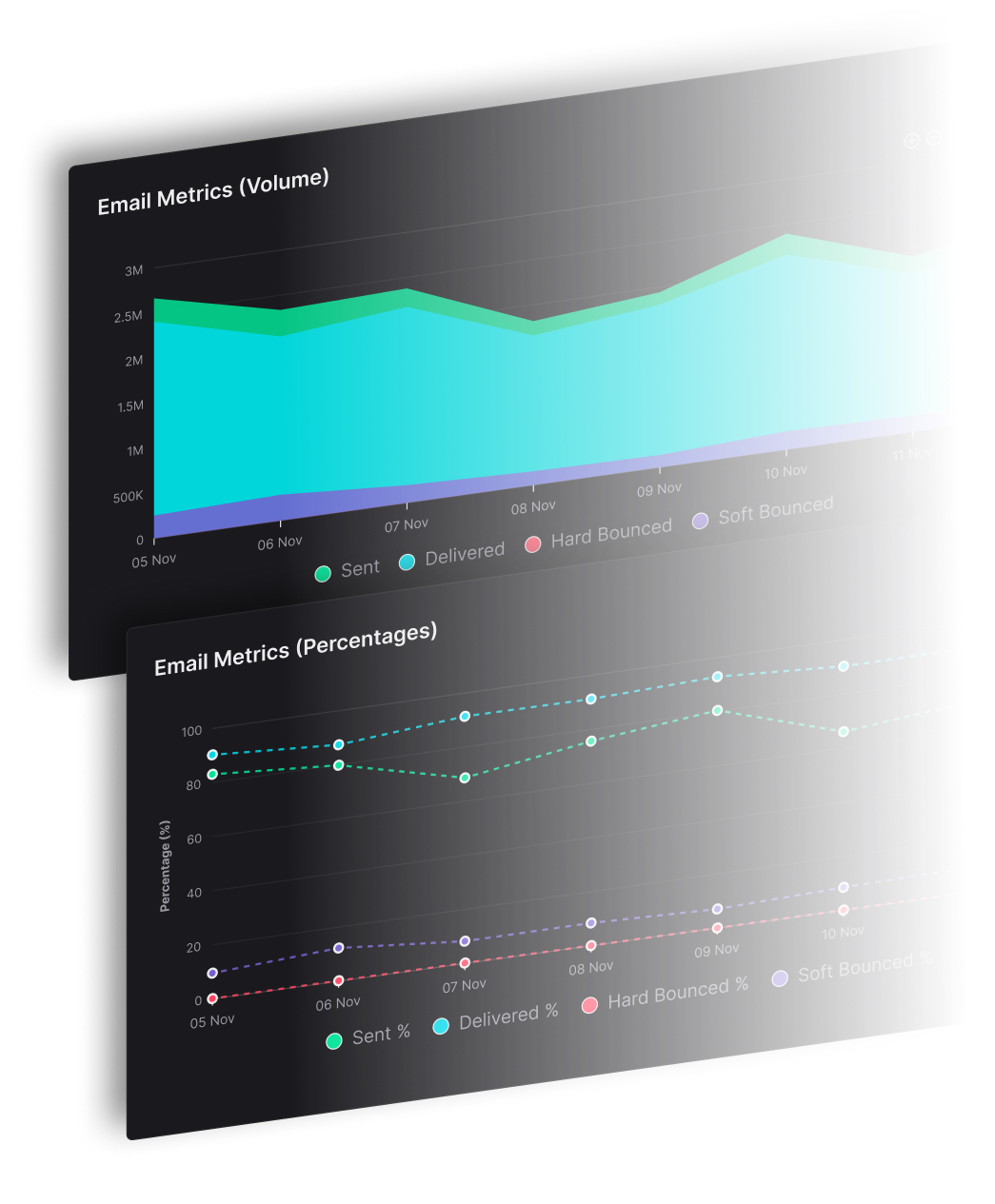


TL;DR:The best transactional email API for most developers in 2026 is Mailtrap for separate sending streams, Postmark for pure deliverability, SendGrid for scale and ecosystem depth, and SendPost for teams who need real visibility into what's happening with their sends. The right pick comes down to three numbers: price per 1,000 emails at your actual volume, the uptime SLA you can hold someone to, and how much you can debug when inbox placement drops. Here's the scored table no other comparison publishes.
Provider | p50 Latency | Uptime SLA | SDKs (languages) | Webhook reliability | Price/1K (100K vol) |
Mailtrap | N/A | 99.99% | 8 (Node.js, PHP, Ruby, Python, Java, .NET, Go, Elixir) | High | ~$0.30 |
SendGrid | 22ms | 99.99% | 7+ | Standard | ~$0.40 |
Postmark | 95ms | 99.99% | 9+ | High | ~$1.30 |
Mailgun | N/A | 99.99%* | 6+ | Standard | ~$0.70 |
Amazon SES | N/A | 99.9% | AWS SDK | Basic | $0.10 |
Resend | N/A | N/A | 9+ (React Email) | Standard | ~$0.90 |
SendPost | 2ms *** | 99.99% | 6 (Go, Java, JS, PHP, Python, Ruby) | Full logs | Contact sales** |
*Mailgun's 99.99% SLA applies on the Scale tier and above.
**SendPost is priced for ESP and SaaS teams, not per-email retail.
***SendPost's 2ms p50 is SendPost internal data. All other latency figures in this table come from third-party benchmarks.
You're not picking a logo. You're picking the infrastructure that fires password resets, receipts, and order confirmations at 3am while your on-call engineer is asleep. Get it wrong and you're debugging blind when it matters most. This guide scores six providers on the five metrics that actually decide the outcome, then tells you which one fits your situation.
The market backs up the stakes. Transactional email is a $1.10 billion market in 2024, projected to reach $2.75 billion by 2033 at roughly 12% CAGR. More products depend on these APIs every year, and the providers know it.
What Makes a Transactional Email API "Developer-Ready"?
Most comparison articles score on brand recognition and a generic pros-and-cons list. That's not what breaks at 3am. Here are the five criteria worth scoring before you sign anything.
Latency. How fast does the API accept and queue a send? The p50 (median) number shapes the user experience when someone clicks "reset password." The p99 (worst 1%) number is what shows up in your own SLA when a spike hits. Fast median, ugly tail, and your checkout flow stalls exactly when traffic peaks.
Uptime SLA. A "99.99%" banner is marketing until it's backed by service credits in a contract. Read what the provider actually owes you when they miss, and on which pricing tier that guarantee kicks in. Some vendors reserve their best SLA for higher plans.
SDK coverage. Official, maintained libraries for your stack beat community ports that lag two versions behind. Check whether your language has a first-party SDK or you're wiring up raw HTTP. If you're evaluating client libraries broadly, our rundown of REST API SDKs is a useful primer.
Webhook reliability. Does the provider retry failed webhook deliveries, and does it hand you delivery events at the SMTP level? This is the difference between knowing a message bounced and knowing why it bounced. Thin webhooks mean you find out about deliverability problems from angry users, not your dashboard.
Price per 1K at real volume. Starter pricing is a hook. The number that matters is your cost per 1,000 emails at 100,000 a month, or a million, or wherever you'll actually land. Providers structure tiers so the cheap headline rate quietly disappears at scale.
The 2026 Scoring Table, Expanded
Same table as above, now with a "best for" read on each provider and the sources behind the numbers.
Provider | Price/1K (100K) | Uptime SLA | Best for |
Mailtrap | 99.9% | Transactional and bulk from one product, with per-provider analytics | |
Amazon SES | 99.9% | Lowest cost, teams who own their stack | |
SendGrid | 99.99% | Scale and ecosystem depth | |
Mailgun | 99.99% (Scale) | SMTP + API hybrid sending | |
Resend | Limited | Modern React/Next.js apps | |
Postmark | 99.99% | Pure transactional deliverability | |
SendPost | Contact sales | 99.99% | ESP/SaaS teams needing visibility |
All prices above are public rates as of mid-2026. SendPost pricing is volume-tier and quoted per account, not sold per email at retail.
Provider Deep-Dives
 Mailtrap
Mailtrap treats delivery data as a product feature rather than a webhook stream you are expected to parse yourself. Transactional and bulk traffic run on separate IP pools by default on every plan, including the free tier, and adding a sending domain generates and validates the SPF, DKIM, and DMARC records for you.
Delivery, bounce, and engagement are reported per mailbox provider. Pricing is $30 a month for 100,000 emails, roughly $0.30 per 1,000, behind a 99.99% uptime SLA, 8 official SDKs, and webhooks that retry on failure. Inbound runs on the same account, with hosted inboxes that accept real mail without MX records, which is the shortest path available if you are working out how to parse emails inside your product.
Right for: teams sending both transactional and bulk from one product who want per-provider delivery data without building the tooling for it.
Wrong for: teams wanting one vendor for SMS and push alongside email
 SendGrid (Twilio)
SendGrid is the default a lot of teams reach for, and the benchmarks explain why the API feels fast. Independent testing clocks its p50 latency at 22ms and p99 at 243ms, with a worst-day peak past 1,200ms. Pricing starts at $19.95/month for 50,000 emails on the Essentials plan, roughly $0.40 per 1,000 at volume. You get 7+ official SDKs and delivery events through the Event Webhook.
The catch is ownership. Twilio bought SendGrid in 2019, and the roadmap now answers to Twilio's enterprise priorities. Some developers report support quality slipping since the acquisition.
Right for: teams already in the Twilio ecosystem, or anyone who needs broad language support plus SMTP fallback.
Wrong for: teams who want hands-on deliverability help without paying up for a premium tier.
 Postmark
Postmark trades a little raw speed for a lot of trust. It runs at 95ms typical API latency with 99.99% uptime, and in a January 2026 head-to-head it posted 99.99% uptime alongside 98.4% deliverability. Pricing is $15/month for 10,000 emails, with overage at $1.30 per 1,000 on the Pro tier. Nine-plus official SDKs round it out.
The reason deliverability holds up: Postmark enforces a strict transactional-only policy. No marketing email shares those IPs, so the pools stay clean. That discipline costs you at scale, where $1.30 per 1,000 adds up fast.
Right for: SaaS products where a password reset landing in spam is unacceptable.
Wrong for: mixed transactional and marketing traffic, or high-volume senders watching price per 1K.
 Mailgun (Sinch)
Mailgun earned its developer following on a solid SMTP relay plus API combo, and it still delivers a 99.99% uptime SLA on the Scale tier. Foundation pricing runs about $0.70 per 1,000 at 50K volume. Sinch acquired it in 2021, and post-acquisition some developers note UI slowdowns and support changes.
Right for: developers who want SMTP, API, and bulk sending under one roof.
Wrong for: teams chasing the absolute lowest price (SES wins) or the deepest deliverability focus (Postmark wins).
 Amazon SES
Nothing beats SES on price. It's $0.10 per 1,000 emails, with a dedicated IP adding $24.95/month, backed by a 99.9% SLA. That's the cheapest option by a wide margin, and for high-volume commodity sends it's hard to argue with.
The price is real, but so is the bill you pay in engineering time. SES has no native dashboard worth the name. Debugging means CloudWatch plus whatever logging you build yourself, and support moves at AWS ticket-queue speed. If you're weighing that tradeoff, our Amazon SES alternative breakdown walks through when the DIY stack stops being worth it.
Right for: teams already on AWS with the DevOps bandwidth to build monitoring.
Wrong for: anyone who needs support or observability out of the box.
 Resend
Resend is the newcomer, launched in 2023 by the team behind React Email, and it shows in the developer experience. Pricing lands around $0.90 per 1,000 at 100K volume, with 9+ SDKs and a clean, modern API. Enterprise features like contractual SLAs and dedicated IP options are still filling in.
Right for: React and Next.js SaaS apps where DX matters and volume is moderate.
Wrong for: high-volume senders who need contractual SLAs and enterprise support today.
 SendPost
SendPost isn't built for the developer sending 20,000 emails a month. It's built for the team that outgrew the black-box APIs and hit a wall. The difference is control: lower-level primitives the major providers don't expose, including per-IP throttling, mailbox-provider-level delivery analytics, and A/B routing tests across providers. If you're coming off SendGrid, the migration guide for moving to SendPost without risking your sending reputation covers the switch.
SendPost's founder makes the case better than a spec sheet can. As Varun Jain, Co-Founder of SendPost, put it on a recent call:
"A lot of this diagnosis I can't even do on SendGrid or Mailgun or SparkPost, because a lot of these lower-level primitives or data visibility is just not exposed. The only way possibly on SendGrid or Mailgun is to consume the webhook, the raw SMTP-level data they're giving you, and start building your own tooling. On SendPost, even a few days of sending throws us enough data, we can quickly understand: is it a provider-specific problem? Is it a list-specific problem? Is the problem related to your sending speed?"
Right for: ESPs, agencies, and SaaS companies sending at volumes where the black-box APIs stop working, or where roughly $440 per million in send cost eats into margin.
Wrong for: developers under 50K a month who don't need deep analytics.
The Consolidation Problem Nobody Talks About
Look at who owns the developer email API market now. SendGrid went to Twilio in 2019. Mailgun went to Sinch in 2021. SparkPost went to Bird in 2022. Three of the biggest developer-facing APIs are now line items inside larger platforms.
That matters more than it looks. Post-acquisition, feature roadmaps shift to serve the parent company's enterprise customers, support quality tends to slip, and API pricing tends to climb as the new owner hunts for margin. Baking your infrastructure into one of these players is a long-term bet on the acquirer's priorities, not the original product you fell for.
SendX advisor Trevor framed the trend plainly on a December 2025 call: "buying versus building is always a better option too... partnerships become vital, especially for smaller players in this space." The read for developers is straightforward. If your sending engine is something you just rent from a giant, you have less control than you think, and you inherit whatever direction the acquirer takes it.
The Hidden Pricing Trap at Scale
Run one calculation before you commit: your cost per 1,000 at your real monthly volume, not the starter tier. The gap is bigger than most teams expect. At 100,000 emails a month, SES costs about $10 while Postmark runs closer to $130. That 13x spread isn't a rounding error.
But the SES number hides a cost that never shows on the invoice. That $10 assumes you build your own logging, monitoring, and throttling stack, and that engineering time is real money. The cheapest API on paper is rarely the cheapest API in practice.
There's a second trap that hits ESPs and SaaS platforms specifically. At SendGrid's highest published tier, 2.5 million emails runs $1,099 a month, about $440 per million. A single customer sending 3 million a month costs you roughly $1,320 in raw send cost before you book a dollar of margin. Push past 2.5 million and the published rates disappear entirely and you're negotiating a custom Premier quote. That math is exactly why an ESP-layer option like SendPost exists.
How to Actually Test an API Before You Commit
Vendor benchmarks are a starting point, not proof. If you want working code to test against, our Node.js and Python email API examples cover send, webhook, and error handling. Run your own eval:
Send 100 emails to a seed list and measure inbox placement at Gmail, Outlook, and Yahoo. For context on what "good" looks like, see our guide on bypassing spam filters for transactional emails.
Deliberately trigger a bounce and time how long the webhook takes to fire.
Try to pull mailbox-provider-level delivery logs. Most APIs won't give you this.
Open a support ticket and clock the response.
Ask directly: can I throttle sending speed server-side, or do I have to build that myself?
That fifth question separates the tools that help you from the tools that leave you flying blind. Deliverability consultant LB Blaire nailed why on a January 2026 call:
"The most common mistake is just getting tooling that doesn't provide the kind of visibility you need. Zero visibility, and the most important thing when it comes to deliverability is catching problems early. What starts as a small throttling event at Hotmail quickly snowballs into zero inbox placement across 10% of your list. And you would not get into a 747 with a pilot that had no instrumentation."
She's right about the stakes. Inbox placement is already under pressure. B2B email delivery rates sit around 98.16%, and inbox placement has slid year over year across major providers. Catching a Hotmail throttle early is only possible if your API lets you see it. Strong email authentication for transactional messages helps too, but authentication you can't monitor is authentication you can't fix.
Verdict: Which API Should You Choose?
Transactional plus bulk with per-provider analytics:Mailtrap
Pure deliverability for transactional alerts:Postmark
Highest volume with ecosystem depth:SendGrid
Lowest cost, own your stack:Amazon SES
Modern React/Next.js SaaS:Resend
SMTP plus API hybrid with flexible routing:Mailgun
ESP or SaaS at scale needing visibility and control:SendPost
For a deeper look at the API layer specifically, our comparison of the best transactional email APIs for SaaS goes further on features and pricing, and if you're still fuzzy on the basics, start with what email APIs are and how they work and what counts as transactional email.
The Real Test Comes at 2am
The scoring table is where the decision starts, not where it ends. The real test is what happens when inbox placement drops in the middle of the night and you have to figure out why. The providers worth paying for are the ones that hand you the instrumentation to diagnose and fix it fast, not the ones that leave you consuming raw webhook data and building your own tooling from scratch.
If you're sending at the scale where the major APIs have quietly turned into a black box, that gap is the whole problem. It's exactly what SendPost was built to close. Pick the API that lets you see what's happening, and you'll spend a lot fewer nights guessing.
