

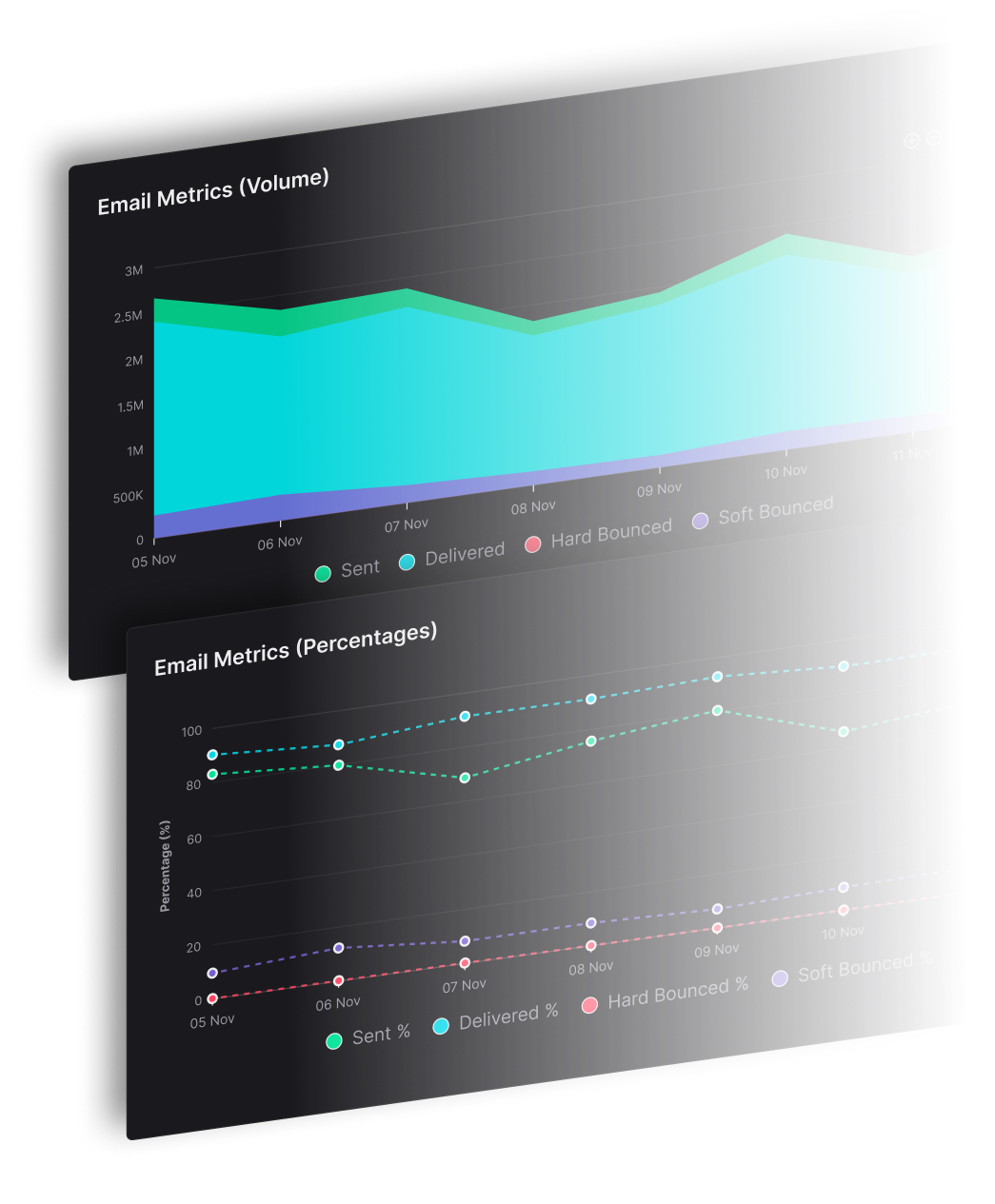


Can you guarantee 100% email deliverability?
No. No email service provider can guarantee 100% deliverability, and any vendor promising it is either misusing the word or counting something other than what you think. Realistic inbox placement for a well-run sending program is 95–98%. The gap between that and 100% is controlled by the receiving mailbox provider, not by you and not by your ESP.
That is the whole answer. The rest of this page explains why the number cannot reach 100, what the vendors quoting "99.9%" are actually measuring, and the three questions that expose the difference.
Delivery rate is not inbox placement
Almost every "guaranteed deliverability" claim survives on the gap between two metrics that sound identical and are not.
Metric | What it measures | A good number | What it hides |
Delivery rate | The receiving server accepted the message instead of bouncing it | 98–99% | Whether it reached the inbox or the spam folder |
Inbox placement | The message landed in the primary inbox, where a human sees it | 95–98% | Nothing — this is the number that matters |
A message that lands in spam still counts as delivered. It was accepted by the server. Nothing bounced. The delivery-rate dashboard stays green.
So a vendor advertising a "99.9% delivery rate" can be telling the literal truth while a fifth of your campaign sits in a spam folder nobody opens. The number is not a lie. It is answering a question you did not ask.
The test: ask whether the number is delivery or placement. If a vendor cannot tell you which one they are quoting, they are quoting delivery.
Why 100% is structurally impossible
Four things sit outside the sender's control, permanently. No amount of authentication, list hygiene, or budget removes them.
Recipient-side rules. Anyone can create a filter that sends your mail to a folder or the bin. That is a decision made inside someone else's mailbox, and no sender can see it or override it.
Mailbox provider thresholds change without notice. Gmail, Outlook and Yahoo each run their own spam models and adjust them continuously. Nobody outside those companies knows the thresholds, and they are not published.
Greylisting and temporary rejections. Receiving servers routinely defer mail on first contact to see whether the sender retries properly. A legitimate message can be delayed or dropped by infrastructure doing exactly what it was designed to do.
Addresses decay. People leave jobs, abandon inboxes, and mistype signups. A share of any list is invalid by the time you send to it, and hard bounces are the correct outcome.
Add these up and 100% is not a target that is merely difficult. It is a number that describes a system nobody has.
So what does good actually look like?
Benchmarks, not promises:
98.16% — the average B2B email delivery rate, with inbox placement sliding year over year across major providers (The Digital Bloom 2025 benchmarks).
98.4% — deliverability recorded for Postmark, one of the strongest transactional performers, in a January 2026 head-to-head (ESP Benchmarks).
95–98% — inbox placement SendX sustains across customer sending.
Note what the ceiling looks like even at the top of the market: the best measured numbers are high 90s, and some of those are delivery figures rather than placement. The honest version of "as close to 100% as possible" is a low single-digit gap that shrinks with good practice and never closes.
If someone quotes you a higher number than the industry's best measured benchmark, that is the moment to ask which metric they mean. For realistic targets for marketing and transactional email, see what a good email deliverability rate looks like by sending type.
The gap is a visibility problem, not a promise problem
The reason to care about the delivery-versus-placement distinction is not pedantry. It is that a delivery-rate dashboard hides the failure until it is expensive.
Deliverability consultant LB Blaire, on a January 2026 call:
The most common mistake is just getting tooling that doesn't provide the kind of visibility you need. Zero visibility, and the most important thing when it comes to deliverability is catching problems early. What starts as a small throttling event at Hotmail quickly snowballs into zero inbox placement across 10% of your list. And you would not get into a 747 with a pilot that had no instrumentation.
A throttling event at one mailbox provider barely moves a blended delivery rate. It moves inbox placement at that provider to nearly nothing. If the only number you watch is the blended one, you find out from a revenue dip weeks later. It's also why it pays to know which ESPs show provider-level deliverability stats before you need them.
That is the real difference between providers: not who promises the highest number, but who shows you per-provider placement early enough to act on it.
How to check any deliverability claim in 10 minutes
Three questions and one test. Run these before signing anything.
"Is that delivery rate or inbox placement?" If the answer is vague, assume delivery.
"Can I see placement broken out by mailbox provider?" Blended numbers hide single-provider collapses. Gmail, Outlook and Yahoo behave differently and need to be visible separately.
"What happens when placement drops — am I alerted, or do I have to go looking?" Detection speed is worth more than a fractional difference in the headline number.
Then run a seed test: send to a seed list spanning Gmail, Outlook and Yahoo, and check where the messages actually land. Cross-reference with Google Postmaster Tools for your domain reputation and spam rate at Gmail specifically.
If a provider will not let you run that test before you commit, you have your answer.
The honest version
You cannot buy 100%. You can reach the high 90s and, more importantly, know within hours when you have slipped, at which provider, and why.
For the tactics that move placement in the first place — authentication, list hygiene, warm-up, engagement — start with our guide to email deliverability.
FAQs
Can any email provider guarantee 100% inbox placement?
No. Inbox placement depends on the receiving mailbox provider's spam filters and on the recipient's own rules, both of which sit outside any sender's or ESP's control. Providers quoting a guarantee are describing delivery rate, not placement.
What is a good email deliverability rate?
For inbox placement, 95–98% is a realistic target for a well-run program. For delivery rate — server acceptance rather than inbox arrival — the B2B average sits around 98.16%.
What is the difference between delivery rate and inbox placement?
Delivery rate counts messages the receiving server accepted, including ones filed as spam. Inbox placement counts only messages that reached the primary inbox. A campaign can show 99% delivery and far lower placement.
Does email authentication guarantee my email reaches the inbox?
No. SPF, DKIM and DMARC are prerequisites rather than guarantees — they establish that you are who you claim to be. Passing authentication and still landing in spam is common when engagement is low or list quality is poor.
Why did my email deliverability suddenly drop?
Most sudden drops trace to one mailbox provider throttling you, a spike in sending volume, or a batch of stale addresses producing bounces and complaints. Per-provider placement data is what makes the cause visible; a blended rate is usually not sensitive enough to show it.
