



Beehiiv has three main plans plus a free tier: Launch (free, up to 2,500 subscribers), Scale (from $43/month on annual billing), and Max (from $96/month on annual billing), with custom Enterprise pricing above 100,000 subscribers. The catch most reviews bury: those entry prices apply only at small list sizes. Scale and Max both climb with your subscriber count, so a 50,000-subscriber newsletter pays roughly 5x the sticker price.
That's the short answer. The rest of this page shows you the exact numbers at each list size, what you get for them, and when a different platform makes more financial sense.
Beehiiv Plans at a Glance
Beehiiv runs four plans: Launch is free up to 2,500 subscribers, Scale starts at $43/month on annual billing for monetization and automations, Max starts at $96/month for multiple publications and branding removal, and Enterprise is custom for 100,000+ subscribers. Annual billing saves roughly 12-16% over monthly. Paid plans include a 30-day free trial.
Plan | Monthly billing | Annual billing | Subscriber cap | Key feature |
Launch | Free | Free | 2,500 | Core sending, basic analytics |
Scale | $49/mo (entry) | $43/mo (entry) | Scales by tier to 100k | Monetization, automations, ad network |
Max | $109/mo (entry) | $96/mo (entry) | Scales by tier to 100k | Up to 10 publications, remove branding |
Enterprise | Custom | Custom | 100k+ | Dedicated IP, account manager, custom terms |
Source: beehiiv.com/pricing, July 2026.
Entry prices apply up to 1,000 subscribers on the paid plans. Costs rise as your list grows. Notable beehiiv publishers include TIME, Newsweek, and TechCrunch.
How Does Beehiiv's Subscriber-Tier Pricing Actually Work?
Beehiiv prices Scale and Max by subscriber count, not by send volume. Your monthly cost increases at fixed thresholds (2,500, 5,000, 10,000, 25,000, 50,000, 75,000, and 100,000 subscribers) rather than per subscriber. There are no per-email overage fees. The price counts all active subscribers, engaged or not, so list hygiene directly affects your bill.
Here's the full Scale and Max tier table:
Subscribers | Scale (monthly) | Scale (annual) | Max (monthly) | Max (annual) |
Up to 1,000 | $49 | $43 | $109 | $96 |
1,001 - 2,500 | $69 | $61 | $149 | $131 |
2,501 - 5,000 | $89 | $78 | $169 | $149 |
5,001 - 10,000 | $109 | $96 | $219 | $193 |
10,001 - 25,000 | $169 | $149 | $289 | $254 |
25,001 - 50,000 | $249 | $219 | $379 | $334 |
50,001 - 75,000 | $289 | $254 | $419 | $369 |
75,001 - 100,000 | $329 | $290 | $459 | $404 |
Source: beehiiv.com/pricing, July 2026.
Read it left to right and the scaling is obvious. Scale runs from $43 to $290 a month on annual billing as you cross from 1,000 to 100,000 subscribers. The cost per 1,000 subscribers actually drops as you grow, from $43 at the 1,000 tier to about $2.90 at 100,000, so the economics improve at scale even as the absolute bill rises.
One thing worth knowing before you commit: beehiiv has raised prices before. The platform moved from flat pricing to subscriber-tier pricing in April 2024, a change that generated significant pushback in beehiiv's own community threads. Check the live page before you sign up, because the tier table is the product here, and it moves.
What's Included in Each Beehiiv Plan?
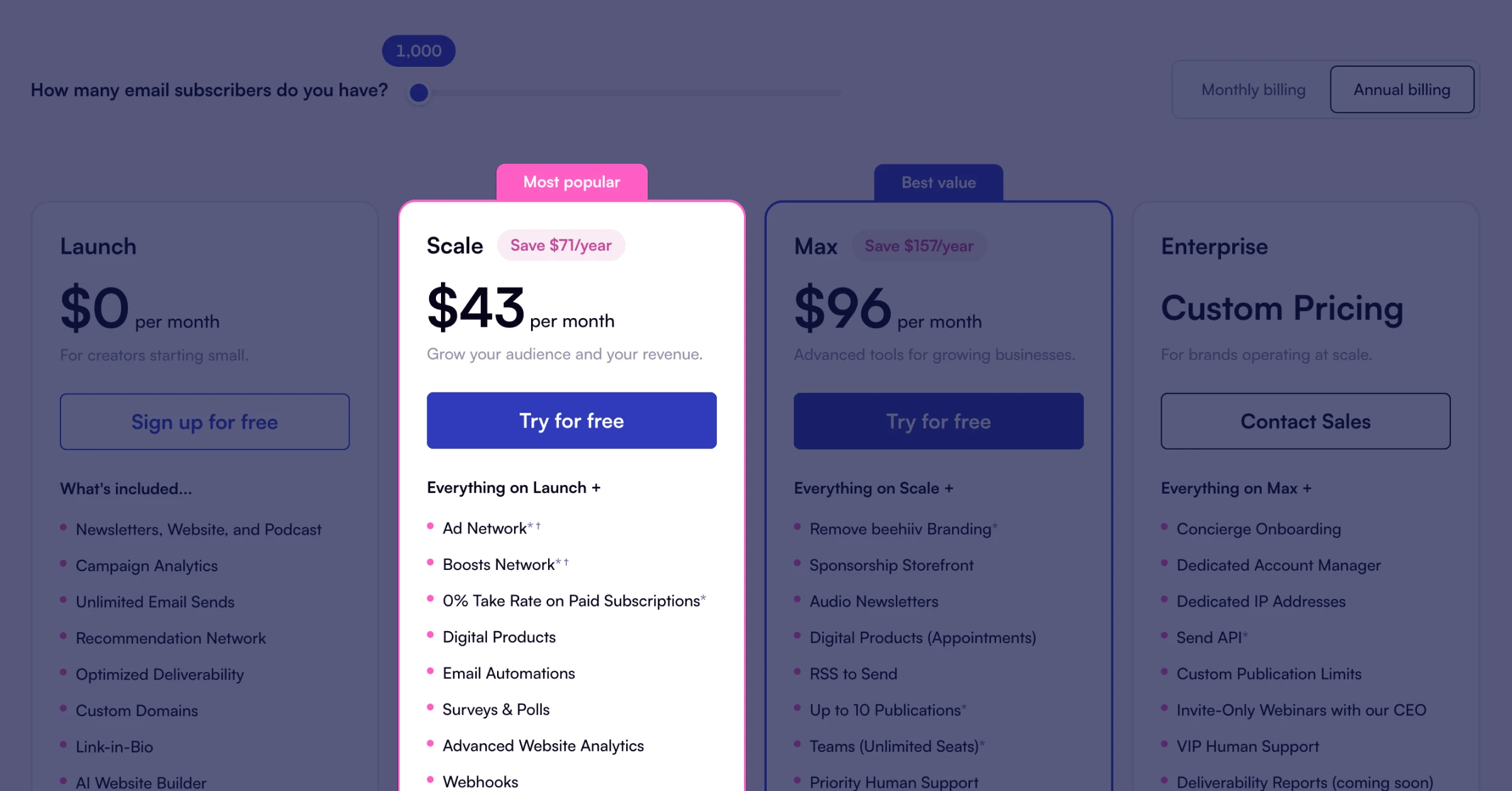 Launch covers core sending and basic analytics with beehiiv branding. Scale adds the money-making layer: paid subscriptions at a 0% platform cut, automations, the Ad Network, Boosts, custom domains, and advanced analytics. Max stacks on up to 10 publications, branding removal, unlimited team seats, podcast hosting, and a sponsorship storefront. The jump from free to Scale is the steepest, because every monetization feature lives behind it.
Launch (free):
Up to 2,500 active subscribers, unlimited sends
Basic analytics and recommendation network
Beehiiv branding on emails and website
No paid subscriptions, no Ad Network, no automations
Scale (from $43/month annual):
Everything in Launch
Paid subscriptions at a 0% platform cut (you keep revenue minus Stripe fees)
Automations, custom domains, referral program, Boosts
Beehiiv Ad Network access and advanced analytics
Up to 3 publications and 3 team seats
Max (from $96/month annual):
Everything in Scale
Up to 10 publications under one account
Remove beehiiv branding, unlimited team seats
Podcast hosting, sponsorship storefront, priority support
The headline financial feature is the 0% platform cut. Beehiiv takes nothing on paid subscription revenue. You pay only Stripe's standard 2.9% plus $0.30 per transaction, so a $10 subscription nets $9.41. Compare that to Substack's 10% cut on paid subscriptions and the gap compounds fast once you're earning real money.
What Do You Actually Get on the Beehiiv Free Plan?
Beehiiv's Launch plan is free forever for up to 2,500 active subscribers with unlimited sends, a hosted newsletter and website, landing pages, and basic analytics. It is a real tier, not a time-limited trial. The limit is on total active subscribers, not monthly sends. The tradeoff is that every monetization feature stays locked, and beehiiv branding appears on your newsletter and site.
What you can't do on Launch: run paid subscriptions, access the Ad Network, use Boosts, or build automations. Those require Scale. There's also a 30-day free trial of the paid plans on signup, so you can test the monetization tools before committing. If you're still deciding what to send, our roundup of the best newsletters is a useful source of format ideas.
The verdict on free: Launch is genuinely useful for getting a newsletter off the ground, and 2,500 subscribers is enough runway to prove the concept. It becomes a problem the moment you want to monetize before hitting that cap, because you'll need to upgrade to Scale immediately. If your plan is to charge readers from day one, treat Launch as a short on-ramp, not a home. For context on what a newsletter actually is and how it differs from broader email marketing, see our guide to newsletters.
Beehiiv Alternatives: What to Use Instead
The best beehiiv alternative depends on what you're optimizing for. Substack costs nothing upfront but takes 10% of subscription revenue. Kit is free up to 10,000 subscribers and strong on digital products. MailerLite is the budget pick for general email. SendX runs unlimited sends with deeper deliverability reporting. Beehiiv wins on newsletter-native monetization; the others win on price or flexibility depending on your model.
Platform | Free tier | Paid starts at | ~10k subs cost | Best for |
Beehiiv | 2,500 subs | $43/mo (annual) | $96/mo (annual) | Newsletter-first monetization |
Unlimited (10% cut) | No monthly fee | $0/mo + 10% of revenue | Writers avoiding upfront cost | |
10,000 subs | $29/mo | Free under 10k | Creators selling digital products | |
250 subs | $12/mo | ~$80/mo (annual) | Budget general email | |
SendX | 14-day trial | $9.99/mo | ~$59.99/mo | Teams wanting unlimited sends |
A few notes on the numbers. Kit's free Newsletter plan covers up to 10,000 subscribers, which beats beehiiv's 2,500 free cap, but at 100,000 subscribers Kit runs about $566/month on its annual plan versus beehiiv's roughly $290/month. MailerLite's Comfort plan starts at $12/month and runs near $80/month at 10,000 subscribers on annual billing (MailerLite, 2026). For a deeper look at how these tools stack up, see our Kit (ConvertKit) pricing breakdown, MailerLite pricing guide, Mailchimp pricing breakdown, and the full email marketing software comparison. If your list is heading toward enterprise volume, our ActiveCampaign pricing guide covers the higher-automation end of the market.
There's a cost category none of these pricing pages list, and it's the one a deliverability expert flagged when we talked through platform selection.
"For any sender that is a newsletter and they're monetizing their newsletter, deliverability is one of the biggest risks you need to manage. It's got to be part of your risk management program. You can end up with your list just dwindling. I had a healthcare newsletter sender that had zero ability to get through the Proofpoint spam filter. That was a third of their list."
LB Blair, deliverability expert at SendX
That's the input no sticker price captures. A newsletter tool shows you opens and clicks. It usually won't tell you which corporate spam filters a third of your list sits behind, or that you're cut off from them. For a paid newsletter, every blocked inbox is a sponsor click or subscription you don't get paid for. This is the one place a general-purpose ESP earns its keep against a newsletter-native platform.
Where SendX Fits
SendX starts at $9.99/month for up to 1,000 subscribers with unlimited sends, and scales by contact count without per-email charges. It's the pick when you need more than a newsletter tool: sequences, advanced segmentation, and deliverability monitoring that surfaces mailbox-provider and corporate-filter performance, not just aggregate open rates.
The tradeoff is honest. SendX doesn't have beehiiv's Boosts marketplace or native paid-subscription billing. If your revenue model is paid newsletter subscriptions plus newsletter ad placements, beehiiv is purpose-built for that. If you're running newsletters as one channel in a broader email program, and you care about catching deliverability problems before they bury your list, SendX costs less and shows you more. Our note on how email pricing actually works walks through the contact-based model in detail.
When Is Beehiiv Scale Worth It?
Scale is the right choice when you're monetizing a newsletter through paid subscriptions, ads, or Boosts. The 0% platform cut pays for the plan once you clear modest revenue: at a $10 median subscription price, roughly 5 paying subscribers covers the $43/month Scale fee, after which beehiiv beats Substack's 10% model. It's the wrong choice if you're under 2,500 subscribers and not yet monetizing.
Scale makes sense when:
You're monetizing via paid subscriptions, where the 0% cut beats Substack's 10% once you have a few dozen paying readers.
You need automations like welcome sequences and re-engagement flows.
You want the Ad Network or Boosts to grow your list.
Scale is the wrong fit when:
You're under 2,500 subscribers and not monetizing. Stay on Launch.
Email is one channel in a larger marketing stack, not a standalone newsletter. A general-purpose ESP gives you more room.
You need multi-brand management. Scale caps at 3 publications; that's a Max feature.
The median beehiiv newsletter sets up a paid tier about 45 days after launch, and subscription revenue now makes up roughly 85% of total creator revenue on the platform, up from about 30% (beehiiv State of Paid Newsletters, 2026). If you're in that monetizing majority, Scale is the tier that pays for itself.
When Is Beehiiv Max Worth It?
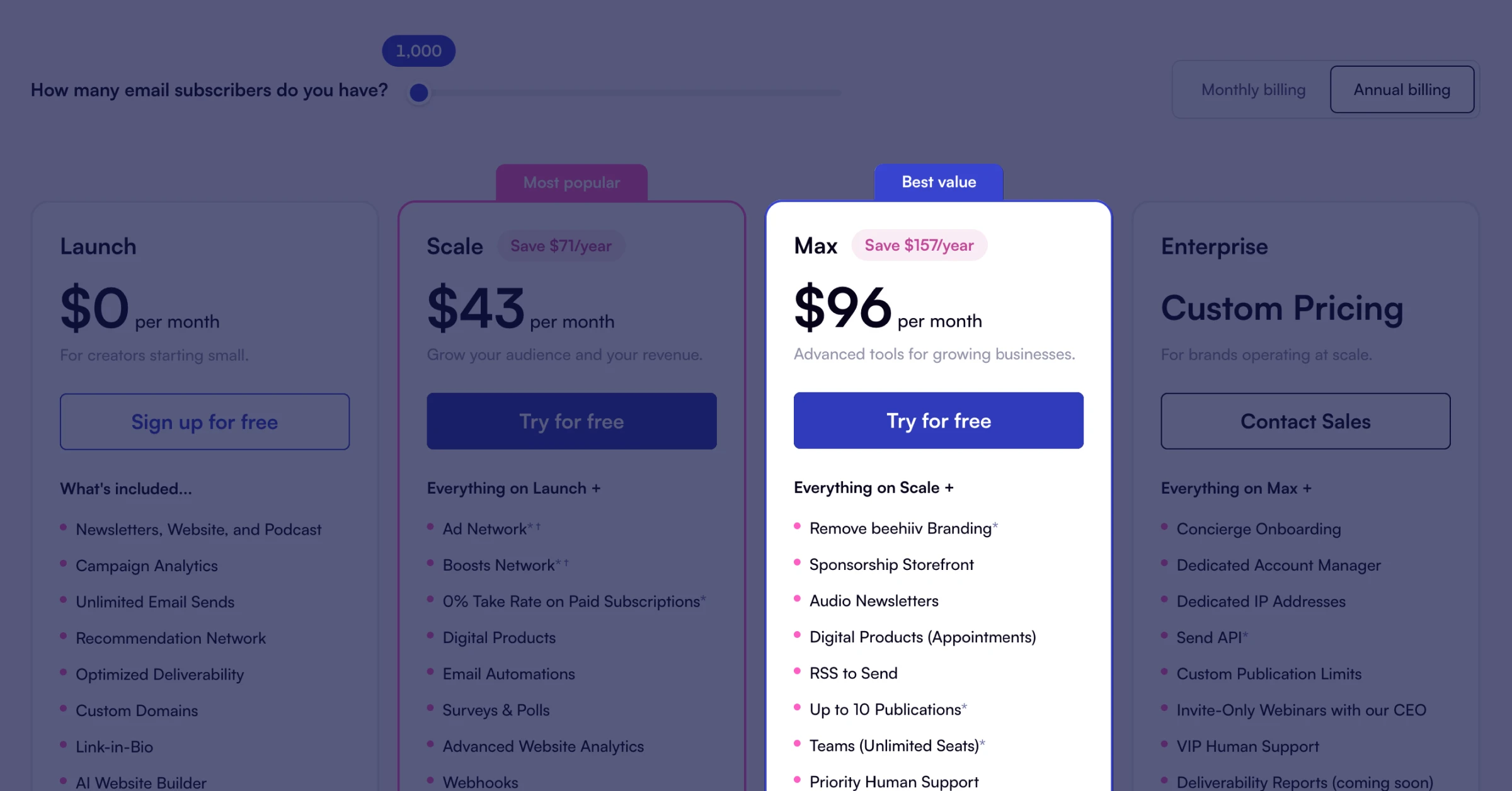 Max is worth the jump to $96/month (annual) when you run multiple newsletters, need to remove beehiiv branding, or want unlimited team seats and a sponsorship storefront. For a single newsletter with no white-label requirement, Max roughly doubles your cost for features you won't use. Scale covers about 95% of single-publication use cases.
Max makes sense when:
You run multiple brands or newsletters, up to 10 publications in one account.
Removing beehiiv branding matters for your positioning.
You're selling sponsorships directly and want the storefront, or you need more than 3 team seats.
The gotcha is simple math. Max starts at $96/month against Scale's $43 at entry-level list sizes. If you have one newsletter and don't need white-labeling, you're paying about $636 a year extra for a footer change. Solo creators should stay on Scale.
What Are the Hidden Costs of Beehiiv?
Beehiiv's pricing is transparent, but four costs catch people off guard: subscriber-tier jumps that raise your bill automatically, Stripe's 2.9% plus $0.30 per transaction, separate Boosts spend for paid subscriber acquisition, and annual billing lock-in. None are hidden maliciously, but all of them land after you've signed up.
Subscriber-tier jumps.Your monthly cost increases automatically when you cross a threshold like 10,000 or 25,000 subscribers. Beehiiv notifies you first, but the bill moves. Pruning unengaged subscribers before a billing date can keep you in a lower tier, and it improves deliverability either way.
Stripe processing.The 2.9% plus $0.30 per transaction is Stripe's fee, not beehiiv's, but it comes out of your subscription revenue. A $10 subscription nets $9.41.
Boosts spend.If you use Boosts to acquire subscribers, that's a separate cost on top of your plan. You set a cost-per-acquisition price per subscriber. Budget it apart from your monthly fee.
Annual lock-in.The annual discount is real, but you're committed for 12 months. If your list shrinks, you keep paying the same rate until renewal.
The cost nobody prices, again, is deliverability. If your sends start landing in spam, the subscribers you paid to acquire stop earning. That's the most expensive line item on this list, and it never shows up on an invoice. Our piece on newsletter content optimization covers the engagement side of keeping mail in the inbox.
Is Beehiiv Pricing Worth It in 2026?
Beehiiv is worth it if you're monetizing a newsletter, and a weaker fit if you're running general email marketing. The 0% revenue share on paid subscriptions is the clearest ROI case: at a $10 median price, around 5 paid subscribers cover Scale's entry cost, and every platform that takes a cut gets more expensive as you grow. For a broader email program with CRM integrations and heavy automation, a general-purpose ESP fits better.
The momentum is real. Paid subscription revenue on beehiiv grew 138% in a single year, from $8 million in 2024 to $19 million in 2025 (beehiiv State of Newsletters, 2026). The share of revenue-generating users earning through paid subscriptions doubled from 15% in Q1 2024 to 30% in Q1 2026, and beehiiv projects paid subscriptions will reach $35 million by the end of 2026, more than tripling since 2021 (beehiiv State of Paid Newsletters, 2026). Independent analyst Sacra estimated beehiiv hit roughly $30 million in annualized revenue by June 2025, up from $19.8 million at the end of 2024 (Sacra, 2026). New launches on the platform reached a median of 482 subscribers in their first month (beehiiv State of Newsletters, 2026).
Yes, if you're building a newsletter business. No, if you're sending email as part of a broader marketing program, where you want segmentation, CRM integrations, and deliverability depth more than a Boosts marketplace.
Which Beehiiv Plan Should You Choose?
Pick by where you are right now. A free newsletter just getting started belongs on Launch. Ready to monetize: Scale. Multiple newsletters or white-label needs: Max. Running email as a broader marketing channel rather than a standalone newsletter: a general-purpose ESP will usually cost less and do more.
Just starting, under 2,500 subscribers, not monetizing:Launch (free).
Monetizing one newsletter:Scale, from $43/month annual.
Multiple publications or branding removal:Max, from $96/month annual.
Email as one channel in a wider stack:a general-purpose ESP like the options in our MailerLite pricing guide fits better than a newsletter-only tool.
The pricing is clear once you map it to your list size and revenue model. Run the tier table against your actual subscriber count before you commit, check the live beehiiv page for any change since June 2026, and don't pay for a monetization layer you're not using yet. For the wider field of options, our best email marketing software comparison lays out where each tool earns its price.
FAQs
How much does beehiiv cost per month?
Beehiiv's Launch plan is free for up to 2,500 subscribers. Scale starts at $49/month (monthly billing) or $43/month (annual billing) for up to 1,000 subscribers, rising to $329/month or $290/month annual at 100,000 subscribers. Max starts at $109/month or $96/month annual, rising to $459/month or $404/month annual at 100,000 subscribers.
Is beehiiv free?
Yes. Launch is permanently free for up to 2,500 active subscribers with unlimited sends and no credit card required. Monetization features — paid subscriptions, Ad Network, Boosts, and automations — require Scale or above.
What's the difference between beehiiv Scale and Max?
Scale adds the full monetization layer: 0% revenue cut on paid subscriptions, automations, the Ad Network, and Boosts, with up to 3 publications and 3 team seats. Max adds up to 10 publications, beehiiv branding removal, unlimited team seats, a sponsorship storefront, and priority support. For a single newsletter, Scale covers nearly everything; Max makes sense when you run multiple publications or need white-label delivery.
How does beehiiv charge for subscribers?
Beehiiv bills by total active subscriber count, not send volume. Prices step up at fixed thresholds: 1,000, 2,500, 5,000, 10,000, 25,000, 50,000, 75,000, and 100,000 subscribers. There are no per-email overage fees. Pruning unengaged contacts before a billing threshold is the main lever to keep your cost in a lower tier.
How much does beehiiv cost at 10,000 subscribers?
At 10,000 subscribers, Scale is $109/month on monthly billing or $96/month on annual billing. Max is $219/month monthly or $193/month annual.
Is beehiiv cheaper than Substack?
Beehiiv beats Substack once you have paying readers. Substack takes a 10% cut of subscription revenue with no monthly fee. Beehiiv charges a monthly fee but takes 0% of subscription revenue. At a $10 median subscription price, roughly 5 paying subscribers covers the $43/month Scale fee — after that, every additional paying reader earns more on beehiiv than on Substack.
Does beehiiv offer a free trial?
Yes. Scale and Max both include a 30-day free trial on signup. The Launch plan is a permanent free tier with no time limit, not a trial.
