



A publication is any work made available to the public in print, digital or email form, including books, newspapers, magazines, academic journals, newsletters and reports. Publication also names the act of releasing that work, whether readers buy a copy, visit a website or subscribe to an email edition.
For publisher groups sending to substantial lists across several titles, releasing content isn't the same as reaching readers. SendX Infrastructure addresses the sending side of that problem. What makes a finished article useful if its audience can't find it or receive it?
Types of Publications and How Each Earns Money
Books, newspapers, magazines, academic journals, newsletters and reports serve different reading habits and business models. Publication type describes the editorial product, while format describes the container carrying it.
| Publication type | Typical format | How it earns money | Audience it reaches |
|---|---|---|---|
| Book | Print, ebook or audiobook | Sales, with royalties paid to authors | Readers who buy or borrow the title |
| Newspaper | Print edition and website | Subscriptions, print and display advertising | Daily local or national readers |
| Magazine | Print issues and digital editions | Subscriptions, newsstand sales, advertising | Readers who follow a subject or interest |
| Academic journal | Articles with DOIs | Subscriptions, article fees, institutional access | Researchers and institutions |
| Newsletter | Email issues and web archive | Subscriptions, sponsorships, paid tiers | Subscribers who opted in to receive it |
| Report or white paper | PDF or web page | Lead generation or brand building, often free | Decision makers in a specific field |
These are common commercial arrangements, not requirements. A magazine can distribute issues free through sponsorship, while a report can sell directly to specialist readers.
How is a type different from a format?
Think of a magazine article as a letter that can travel in different envelopes. The same article can appear on a web page, inside a downloadable PDF and within an email issue without becoming a different editorial product.
The format changes the reading experience and distribution route. A web page needs a usable mobile layout, a PDF needs readable pages, and an email issue needs to survive the trip through a mailbox provider.
Revenue also needs a payer. Book buyers pay for access to a title, institutions may pay for journal access, and sponsors pay to reach a newsletter's audience. A free report instead supports a broader business by attracting interested readers.
Which type fits the business?
An editorial team can identify its publication by answering these questions:
- Reader: Who returns for the subject, reporting or practical guidance?
- Cadence: Does the work appear as a standalone release or as recurring issues?
- Payer: Does revenue come from readers, advertisers, sponsors or another business activity?
A recurring email briefing for opted-in industry readers is a newsletter, even when its archive resembles a magazine website. For established newsletter businesses evaluating operating costs, SendX's newsletter publishing costs and alternatives guide provides a separate commercial comparison.
The useful classification is the one that matches the reader relationship and payer, not the file extension.
How a Publication Moves From Draft to Reader
An editor catches a wrong date in a finished proof the night before release. The fix takes minutes; publishing it would have meant a public correction. Every stage between draft and reader exists to catch exactly this kind of failure, and each stage has a different owner.
Skipping a stage hands that owner's job to someone who cannot do it. A missed check does not disappear. It resurfaces as a broken access link, a catalog record with no author, or an error already sitting in readers' hands.
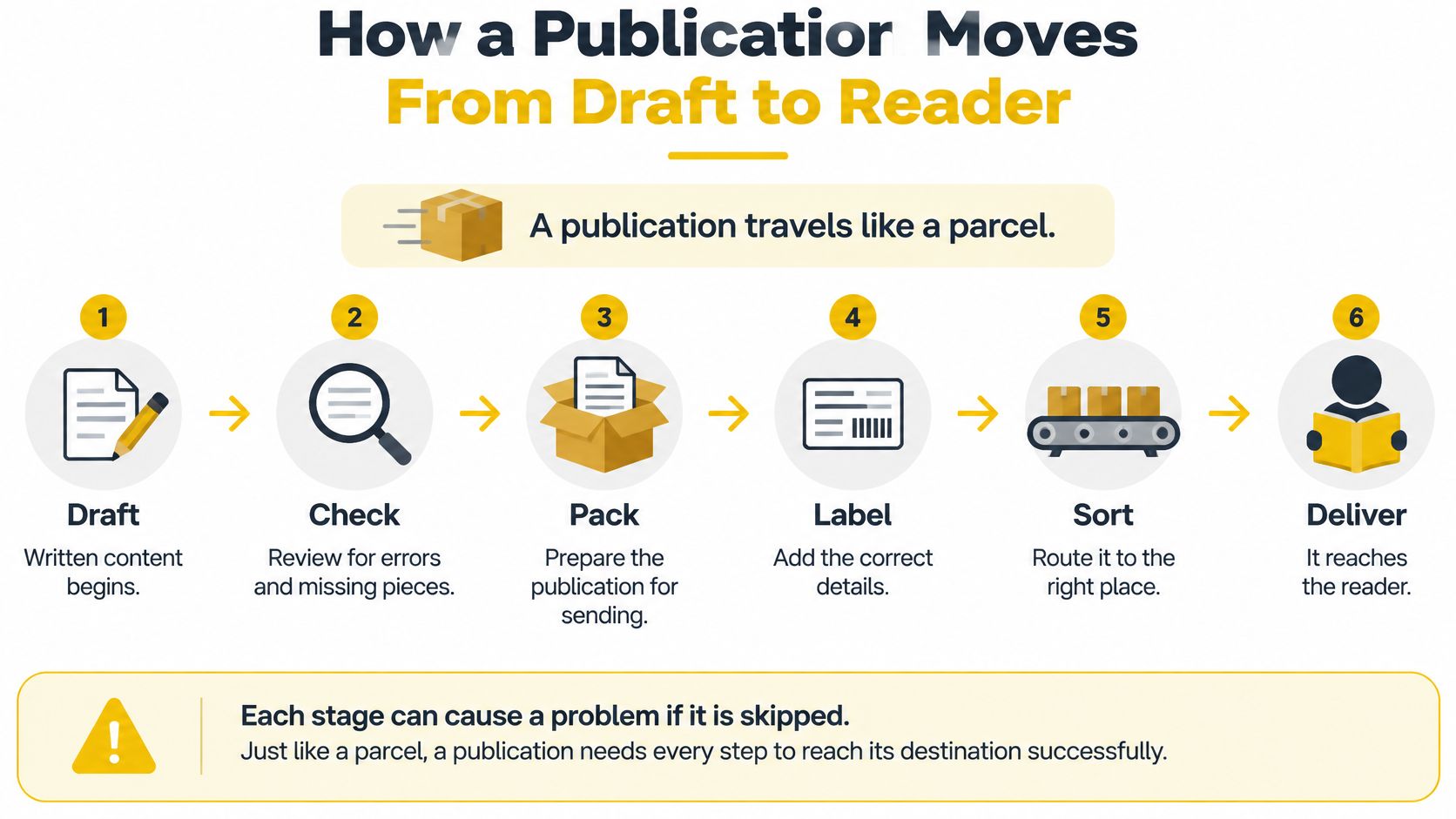
What happens at each publishing stage?
- The author drafts the work. The draft establishes the subject, argument and intended reader. Starting without an audience or purpose often produces text that an editor must rebuild rather than refine.
- An editor or peer reviewer checks it. Editors examine clarity, structure and factual support; scholarly reviewers assess research within their expertise. Skipped review can let an unsupported conclusion or factual error reach the final edition.
- Production prepares the format. Designers and production staff turn approved material into a print file, ebook, web page or email issue. A layout that looks correct on a large monitor can still become unreadable on a phone.
- Metadata identifies the work. The publisher adds the title, author, publication date and applicable identifier. A missing author name makes catalog searches and attribution harder.
- Distribution routes the release. Stores, subscription systems, websites and sending infrastructure carry the work toward readers. An incorrect destination or broken access link can make finished content practically unavailable, and for email issues a mailbox provider still decides whether the message reaches the inbox.
- Readers respond. Purchases, reading activity, shares and corrections inform later releases. Ignoring corrections leaves both the public record and the next issue vulnerable to repeated mistakes.
Why does publishing scale require careful interpretation?
Historical figures show how large and uneven the distribution system became. UNESCO estimated approximately 5 billion physical copies annually across more than 60 publishing countries in its historical survey, with roughly three-quarters originating in 10 countries and approximately 90% produced in 8 languages.
These aren't current annual production figures. UNESCO also warned that no universally accepted definition of a book existed, so national counts didn't necessarily measure identical things.
That caveat matters when comparing publication totals. A count of physical copies isn't a count of distinct titles, and neither measures how many people read them.
Ownership is the practical point at every scale. The author owns the argument, the editor owns accuracy, production owns readability, and the publisher owns identification and routing. The reader owns the verdict that shapes the next release. A publication that reaches its audience reliably is one where each owner finished a stage before handing the work on, because editorial completion and successful distribution remain separate responsibilities.
Identifiers and Metadata That Make a Publication Findable
Two articles can share a nearly identical title, and one book can exist in several editions at once. Identifiers and metadata exist so catalogs, websites and research systems can tell them apart.
Metadata means structured information about a work, such as its title, author and date. An identifier pins down which work, edition or serial that information describes inside a particular identification system. When both are recorded correctly, a reader searching a library catalog or a citation index reaches the exact item the author released, even across millions of records.
Which identifier belongs to which publication?
| Identifier | What it identifies | Concrete example |
|---|---|---|
| ISBN, International Standard Book Number | A particular book edition and format | A paperback edition distinguished from its ebook edition |
| ISSN, International Standard Serial Number | A continuing serial title | A recurring magazine or academic journal |
| DOI, Digital Object Identifier | A registered research object | A journal article or dataset with a maintained landing-page destination |
An identifier points to one edition or serial. A title can appear under several publications and can change its presentation across catalogs and websites, which is why identifiers carry the load in any system that has to match records at scale.
Crossref's metadata model supports at least 13 research-output types, including journal articles, conference papers, datasets, reports, preprints, peer reviews and grants, according to its description published in 2020.
That model treats a DOI as a maintained record rather than text pasted into a reference list. The DOI resolves to a landing page, while associated metadata can record authors, affiliations, abstracts, funding, licenses, citations and changes to the publication.
What must the publisher maintain?
A DOI works like a forwarding address. When content moves, the publisher must update its destination so the identifier continues reaching the correct landing page. Consider a journal that migrates its archive to a new platform: every article keeps its DOI, but if nobody updates the registered destinations, each link lands on a dead page and the articles effectively vanish from citation trails.
Whoever registers the identifier holds the responsibility for keeping it current.
Corrections, updates and retractions also need explicit relationships. Otherwise, someone may discover an earlier version without understanding its status.
A DOI certifies identity and location. Judging quality still requires the methods, supporting evidence, review history and correction record behind the work.
For a newsletter archive, a stable URL, visible date and clear byline serve comparable discovery and attribution purposes, even though the page never becomes a DOI-registered object.
An editorial team can check publication records through these practical tests:
- Identity matches: The title and author agree across the publication and its catalog record.
- Dates are distinguishable: Original publication and later updates appear as separate events.
- Destination works: The identifier reaches the intended item, with version and correction information visible.
How Publications Reach Readers Across Channels
Distribution belongs in any explanation of publication because readers arrive through routes controlled by different organizations. A publisher can release the same work everywhere without having the same relationship with readers everywhere.
| Channel | How readers arrive | Who owns the audience relationship | Main risk |
|---|---|---|---|
| Search | Readers enter a query and click a result | The search engine controls initial discovery | Rankings and answer layouts can change traffic |
| Social feeds | Readers see a post and click through | The platform controls feed access | Feed rules determine distribution |
| Email newsletter | Subscribers receive an issue | The publisher manages a permission-based relationship | Authentication and complaints affect inbox placement |
| Apps and push alerts | Readers open installed software or permit alerts | The publisher manages the direct relationship, subject to distribution permissions | Installation and notification retention require reader commitment |
| Syndication and RSS | Partners republish content or readers request feed updates | Shared with partners or managed through reader subscriptions | Republished copies can compete with the original |
| AI answers | Readers encounter a summary and sometimes a source link | The answer service controls the interaction | The answer may satisfy the query without a visit |
Audience ownership doesn't mean owning people. It means having a permission-based way to contact readers without needing a feed or search result to introduce the publication again.
Why should the phone shape publication design?
Pew Research Center's summary through 2023 reported that about 93% of U.S. adults received at least some news online through a mobile device or desktop computer. Its historical outlet analysis also documented mobile audiences exceeding desktop audiences at many studied outlets.
The operational lesson is to test the actual reading surface. Headlines, subscription forms, tables and article links should remain usable on a phone rather than merely shrink to fit it.
An email subscription is valuable only when the reader understands what will arrive. An app installation isn't permission for every possible notification, and a registered account doesn't automatically authorize unrelated marketing.
How should a publisher measure owned and rented reach?
Start with a channel report that distinguishes first discovery from repeat contact. Search may introduce a reader who later becomes a newsletter subscriber, so crediting only the last visit hides part of the journey.
- Discovery: Record which channels introduce new readers.
- Direct return: Track visits and reading generated through permission-based contact.
- Business contribution: Connect those relationships to subscriptions, sponsorship value or another defined outcome.
The distribution KPIs for small publications offer a starting checklist that larger teams can adapt title by title. SendX's email marketing strategy for publishers addresses the email-specific planning.
For a publisher without a permission-based return channel, an explicitly described newsletter is a practical place to begin.
Newsletter Rules That Protect Your Sends
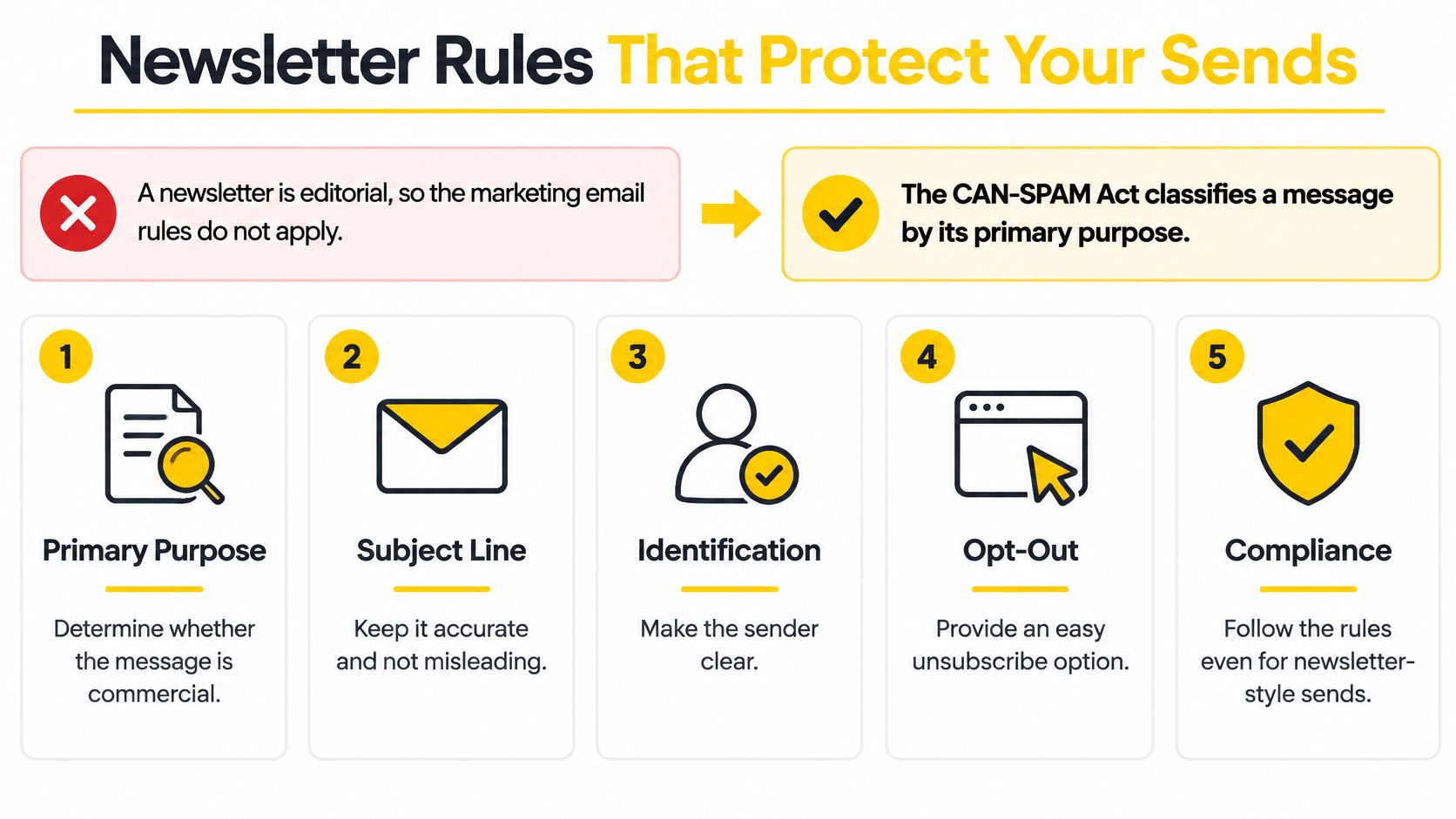
A weekly digest can carry a vendor's sponsorship block and still read as editorial, or become an advertisement when the offer dominates the issue. In the United States, the CAN-SPAM Act classifies a message by its primary purpose, so the team should judge what a reasonable recipient would think the email is mainly trying to do.
The FTC's CAN-SPAM Act compliance guide states that bona fide newsletters have no blanket exemption and that marketing email needs accurate sender and routing information, a nondeceptive subject, a valid physical postal address and a clear opt-out. The opt-out must remain functional for at least 30 days after sending, and requests must be honored within 10 business days.
A sponsorship, subscription pitch, affiliate block or dedicated offer should trigger that assessment before send. Presence alone does not settle classification.
The checklist below separates message classification from the technical requirements that affect delivery.
What does Gmail require from bulk senders?
Legal compliance can still fail at the mailbox. Google counts senders reaching 5,000 messages in 24 hours to personal Gmail accounts as bulk senders, grouping mail from the same primary domain, and it requires the Postmaster Tools spam rate for that domain to remain below 0.30%.
Gmail's bulk-sender requirements include SPF and DKIM authentication, DMARC, valid forward and reverse DNS, and TLS encryption. For direct mail, the visible From domain must align with the SPF or DKIM domain.
A received header shows the division of labor. In Authentication-Results: mx.example.com; spf=pass smtp.mailfrom=news.example.com; dkim=pass header.d=example.com; dmarc=pass header.from=example.com, SPF checks whether the connecting server may send for the MAIL FROM domain, DKIM verifies a signature tied to example.com, and DMARC asks whether the visible From: domain aligns with an authenticated domain. DNS publishes the records those checks rely on, while TLS protects the connection carrying the message.
From Gmail's side, authentication establishes identity and recipient spam reports signal unwanted mail. Delivered means accepted by the mailbox provider; it does not promise inbox placement.
What should the team verify this week?
- Classify each issue. Review its primary purpose rather than assuming every editorial template receives the same treatment.
- Check visible identity. Inspect sender details, subject lines and the postal address in an actual received message.
- Test opt-outs. Follow the recipient's path and confirm that the suppression reaches the sending workflow.
- Validate authentication. Have the sending team check authentication, alignment, DNS and encryption before volume grows.
- Review complaints alongside engagement. Use open and click-through rate stats as context, not as substitutes for title-specific complaint monitoring.
SendX's CAN-SPAM Act guide adds operational context for newsletter teams.
Running Several Titles Without One Hurting the Rest
Multi-title publishing adds a distribution problem that single-title teams don't face. When publications share a sending domain and IP pool, complaints about one title can affect infrastructure used by the others.
Mailbox providers evaluate the identities and sending infrastructure visible in the messages, so an account boundary alone changes nothing for them. Shared resources also make diagnosis harder when editorial teams have different audiences and sending habits. A complaint spike on a weekend lifestyle title can pull down inbox placement for a weekday business publication that shares its pool, even though the two audiences never overlap.
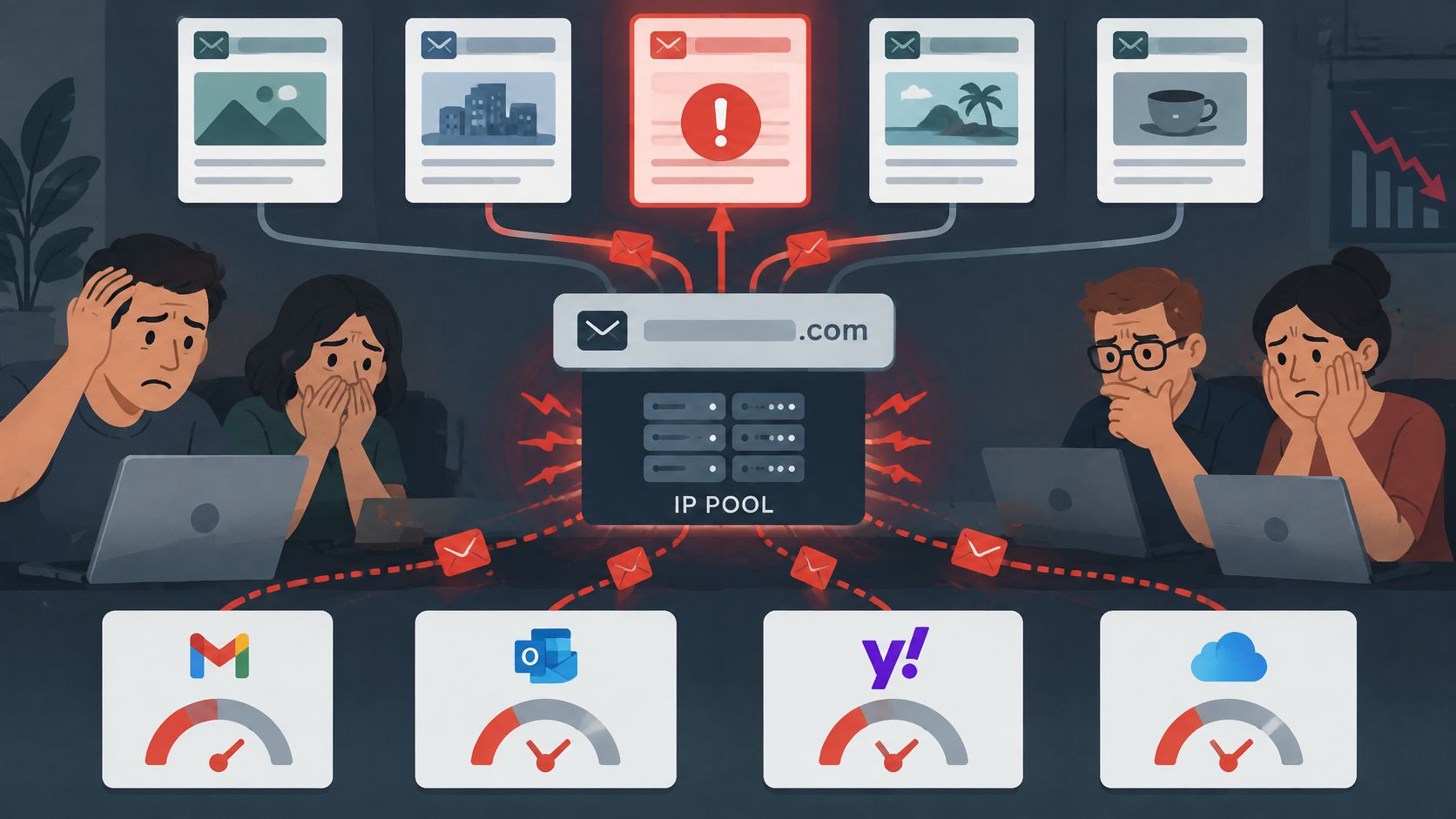
How should titles be separated?
Running this manually means maintaining each title's sending domain, authentication records, IP assignment and reporting. A business publication and a lifestyle newsletter shouldn't need a spreadsheet investigation to determine which audience generated complaints.
SendX handles this through subaccounts on its managed sending infrastructure: each publication gets a separate API key, its own domains and its own IP pool, so the team assigns the title's sending identity before routing any messages through it.
Separate it means giving each brand its own domain, IPs, pool, warmup plan and throttles so shared sending resources don't make one title's reputation problem the others' problem. Separate titles can still run into the same mailbox-provider issue; what separation prevents is one title's specific trouble spreading to the rest.
For owners and heads of audience, separation makes title-level accountability possible. For CTOs sending on behalf of users, the same principle applies to tenant boundaries.
The distinction between presentation and delivery also matters in white-label email marketing. Branded software alone doesn't establish separate sending identities.
What should the team see when delivery changes?
See it means seeing what happened at every inbox and knowing what to fix next, per brand, per mailbox provider and per IP, down to the bounce code. Accepted-message events still shouldn't be mistaken for proof of inbox placement.
Monitoring has to reach the title level to be useful. Domain reputation data and blocklist checks across IPs, domains and tracking domains let a title-specific investigation start with that title's own infrastructure, while webhooks route each title's events to its own destination. If complaints spike on one title's domain after a send, that title's event stream carries the signal and the others stay clean and readable.
The following video provides additional sending context.

Switch it means proving the arrangement on one brand first, with the current provider still running underneath, and retaining the ability to switch back. The result is title-level evidence and control rather than a portfolio average that conceals which publication needs attention.
Choose the Setup Your Publication Needs First
The setup decision belongs at the title level because each publication has its own audience, commercial purpose and sending behavior. Buying more software before documenting those differences leaves the operating problem unresolved.
What should the publisher decide first?
- Inventory every title and relationship. Record subscribers, registered readers, paying members and other identifiable audiences separately. A follower count shouldn't stand in for a contactable subscriber list.
- Rank channels by controllable access. Distinguish permission-based return channels from discovery channels. Assign an owner to improve the next useful reader action, such as subscribing after reading an article.
- Review bulk-sender readiness. Combine sending volumes across the primary domain when assessing Gmail's classification. The technical owner holds responsibility for authentication and transport checks, separate from the editorial launch checklist.
- Map domains to IP pools. Identify shared resources before assigning titles to separate workflows. A different From name isn't evidence of independent infrastructure.
- Choose an early-warning measure per title. Complaint rate is useful for detecting unwanted mail; delivery failures and deferrals help identify technical trouble. Each measure needs a named person responsible for investigating changes.
A comparison of email marketing service types and costs can help distinguish campaign-software decisions from delivery-engine decisions.
When does managed sending fit?
A three-title operating map makes the choice concrete. The daily news bulletin serves opted-in subscribers on news.example.com with the audience editor owning complaints; the weekly paid magazine serves members on magazine.example.com with the membership lead as owner; the monthly archive digest reaches registered readers on digest.example.com with the technical owner watching deferrals.
SendX Infrastructure fits publisher groups that need separate domains and IPs per title, with results tracked independently for each. The decision works best once the operating map exists.
A team can begin with the title whose permissions and sending history are clearest, often the daily bulletin, where consent records and complaint trends already exist. The evaluation then stays focused on delivery controls and usable evidence.
FAQs
Is an issue the same as an edition?
An issue is a particular installment of a serial, such as a magazine's monthly release. An edition is a particular version of a work, such as a revised textbook or a regional newspaper edition.
Does publication transfer copyright?
Making a work public does not by itself transfer copyright. A freelancer who writes an article keeps the rights unless the contract assigns them to the publisher, so the employment, publishing or licensing agreement is the document that decides who may reuse the work and where.
What should a publication archive preserve?
An archive should preserve the released content, issue or edition identity, original publication date and subsequent correction history. Keeping only the latest rewritten page can erase the record needed to understand earlier citations.
Can a private subscriber newsletter count as a publication?
Yes. Paywalls and member logins still produce published work, because publication means making content available to an audience, not making it free. A memo circulated only inside one company serves a different purpose from a newsletter offered to subscribers who chose to receive it.
Build a sending setup that keeps each publication's identity, infrastructure and results distinct. Visit SendX to discuss managed sending for a publisher group and evaluate the first title while retaining the option to switch back.
