


Fashion emails now play a larger role in the shopping journey.
The old purpose was simple: show a product or discount and direct the reader to the website.
In 2026, that role has expanded.
The inbox can support styling, personalization, entertainment, and product discovery before shoppers reach the website.
The following examples show how fashion brands are putting that shift into practice.
Highlights
Give shoppers more to do than look and click by helping them discover, compare, personalize, or build a look.
Make the inbox shoppable with familiar ecommerce UX.
Turn interaction into intent by giving customers a reason to participate.
Leave something for the click so curiosity leads to conversion.
The role of fashion email is changing in 2026
The age of the read-only fashion email is over. Now it’s a back-and-forth.
Customers can:
Get recommendations based on their behavior and preferences.
Browse products before hitting the website.
Interact with quizzes, polls, and carousels.
Choose what they’re interested in.
Build outfits, bundles, or kits.
When the inbox goes from waiting room to fitting room, the email becomes part of the shopping experience.
Here are six brands giving their email campaigns more to do. 👇
6 fashion email examples worth studying in 2026
These brands are putting their inboxes to work. Each example demonstrates a tactic that other fashion brands can adapt.
1. Lane Crawford: Using AI recommendations to become a personal stylist
Give your product recommendations some fashion sense.
A customer looking at a skirt doesn’t necessarily need six more skirts. They might need the shoes, jacket, and bag that make that skirt work.
Take Lane Crawford.
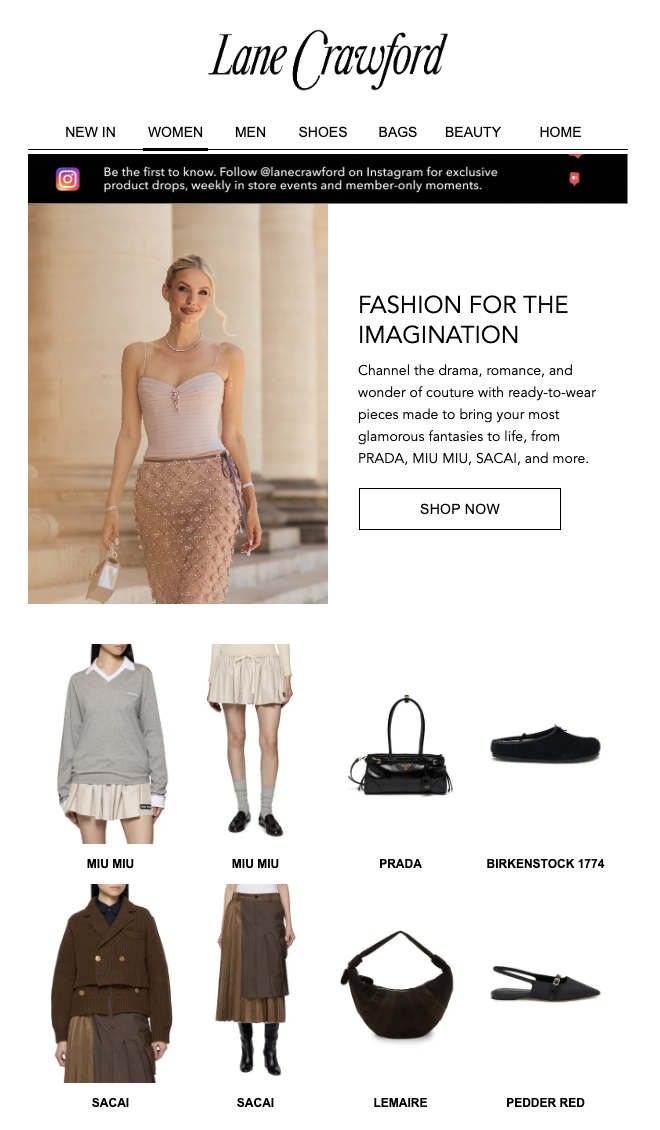
Lane Crawford AI Recommendation Email
Source: Milled
It uses AI to recommend the rest of the outfit around pieces customers are interested in. As AI-powered shopping experiences become more sophisticated, a Control Plane for AI Agents can help businesses coordinate and manage the AI systems behind these personalized customer journeys.
The value is that a single product interaction can become a broader styling opportunity.
Apply this approach by changing the recommendation question from “What’s similar to this?” to “What goes with this?”
This approach also gives recommendation blocks a clearer purpose. Instead of repeating products from the same category, fashion brands can organize suggestions around a complete look.
A shopper viewing a skirt, for example, could see shoes, outerwear, and accessories that complement it. The recommendation becomes more useful because each item supports the original product interest.
2. Protest: Turning the inbox into a storefront
Make the email feel shoppable before customers reach the website.
Protest does this by making its mix-and-match swimwear email feel like an ecommerce page.
The email uses a product grid, color swatches, and individual product options. These familiar ecommerce cues make the message function more like a shopping interface.
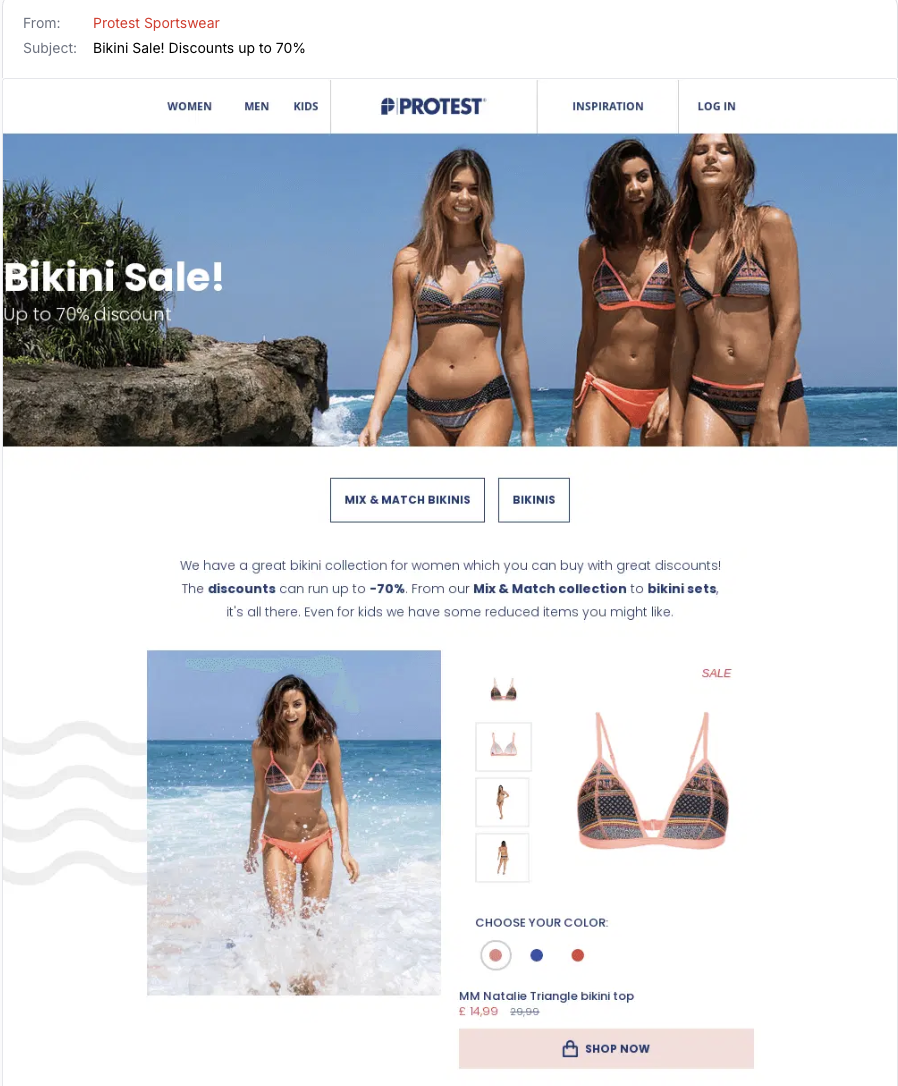
Protest eCommerce Email with Bikini Product
Source: Really Good Emails
Suddenly, you’re not reading about a bikini sale. You’re choosing a bikini.
The layout makes the email feel closer to a storefront than a standard promotional message.
Fashion brands can apply the same idea by reducing the steps between product discovery and selection. Showing key variants, prices, or compatible items inside the email helps shoppers evaluate options before reaching the website. The same approach can also work for higher-consideration ecommerce products: an email featuring a leather reclining sofa, for example, could preview upholstery options, configurations, and pricing before sending the shopper to the full product page. The goal is not to replace the product page. It is to make the next click feel like a natural continuation of the shopping process.
Start the shopping journey in the inbox, then use the next click to continue it on the website.
3. Hûha: Using interactive content to collect preference data
Use interactive content to make preference sharing more appealing.
Zero-party data can improve segmentation, but customers still need a reason to share it.
Hûha approaches the problem with a horoscope-themed campaign.
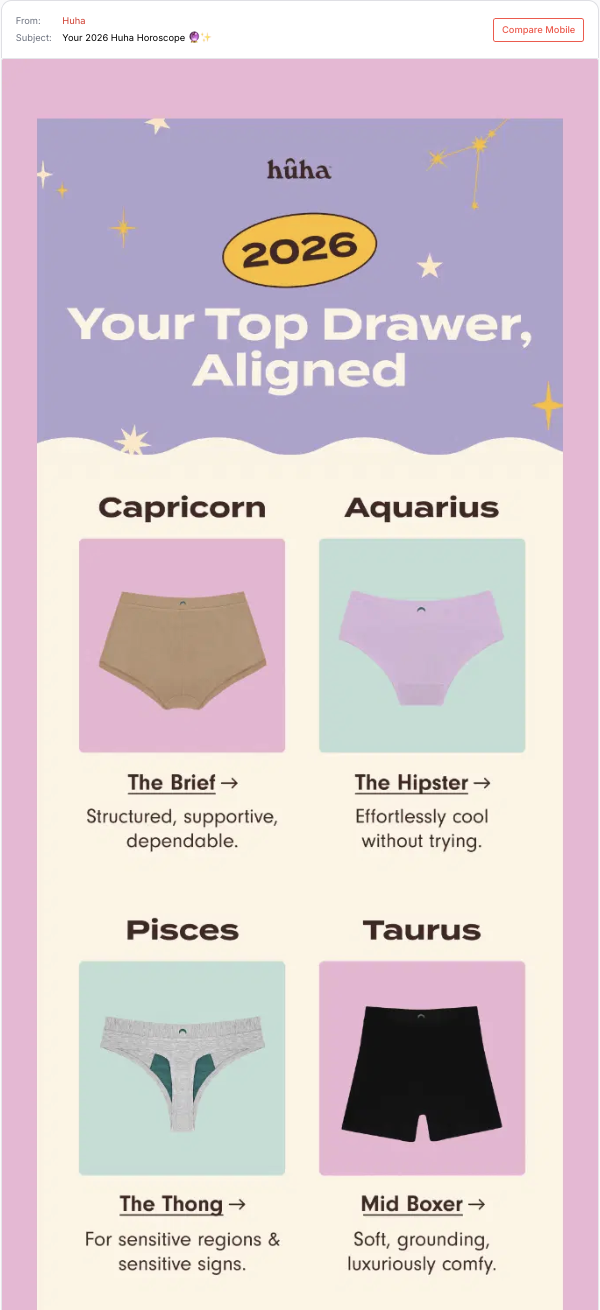
Hûha Horoscope Email
Source: Really Good Emails
Customers click by star sign, giving Hûha a lightweight preference signal that can support future segmentation.
And that’s the trick to deeper personalization. Design your zero-party data games around crossover clues so each interaction can provide a useful preference signal.
4. Patagonia: Competing for attention like a publisher, not a retailer
Give your brand values their own column inches.
Fashion’s next generation is putting values on the shopping list. As YouGov found, 65% of Gen Z like companies with a moral message, and 63% are more likely to buy from brands that express views they agree with.
Patagonia gives those values the headline treatment.
Its Water Talk email reads like surf journalism: stories, conditions, and culture, with barely a product in sight.
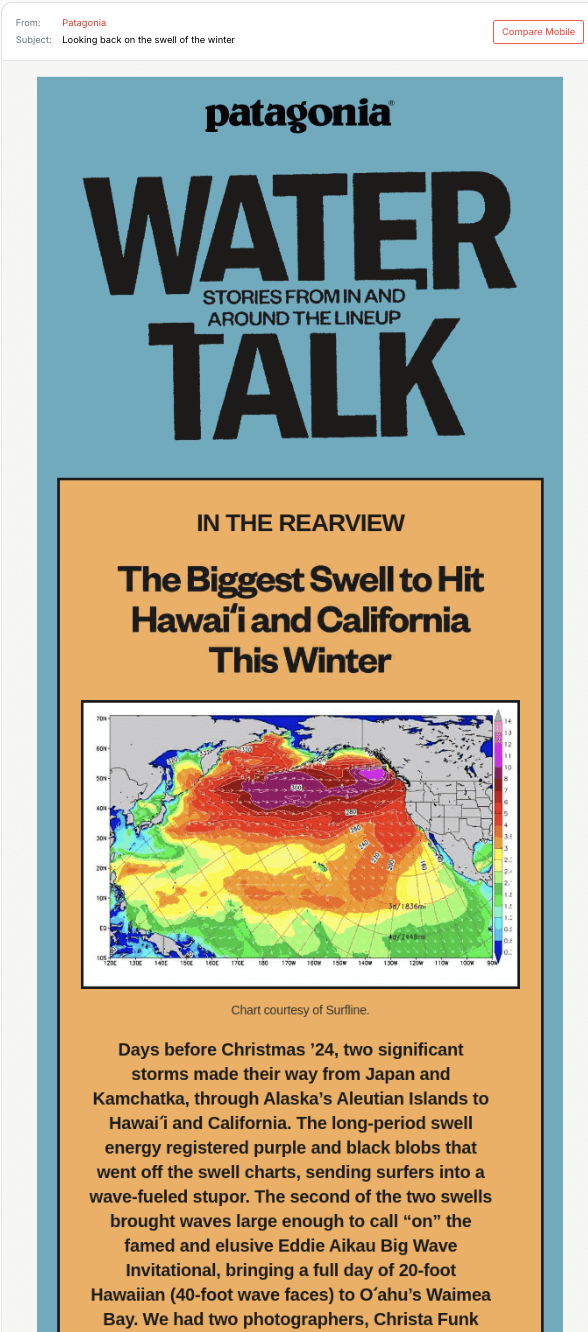
Patagonia Water Talk Email
Source: Really Good Emails
For customers who share those priorities, the editorial approach reinforces Patagonia’s brand positioning.
Reinforce those values by thinking like a publisher.
Give customers something to read, watch, or follow that consistently reflects what the brand stands for.
5. Moment: Making upselling feel like customization
Turn “buy more” into “build yours.”
Moment wants to sell you a bag, along with the organizers, slings, and accessories that go with it.
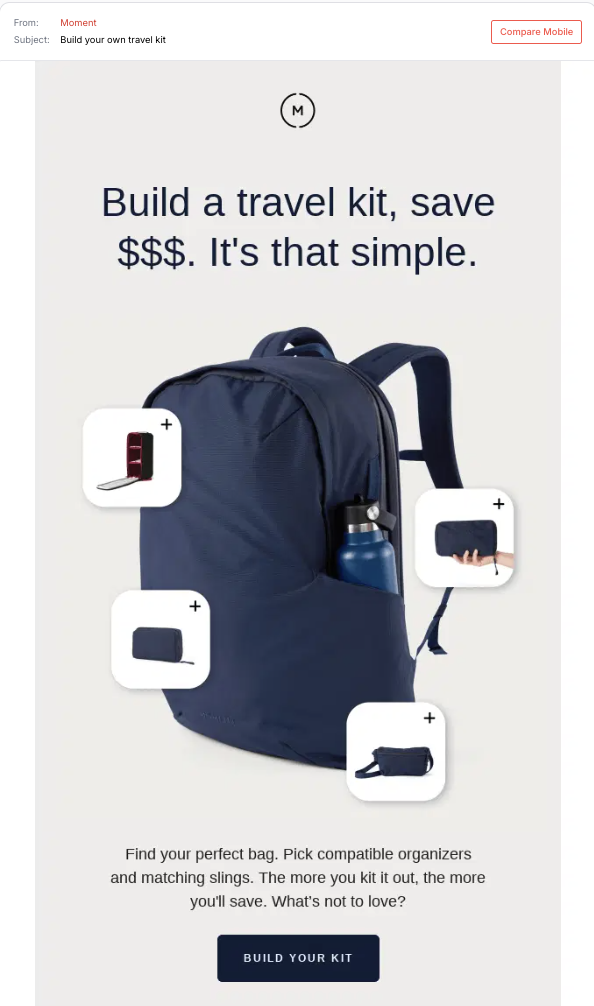
Moment “Build Your Kit” Email
Source: Really Good Emails
But “Build Your Kit” makes that upsell feel more like customization than an add-on.
Moment frames the additional products as parts of a complete travel kit rather than separate add-ons.
For fashion brands, the same structure could turn a single purchase into a coordinated set. A jacket could be paired with trousers, a bag, or accessories under a simple build-your-look concept. The important part is to present the extra items as useful parts of one choice rather than unrelated products added to the basket.
This approach makes the additional purchase feel like completing a set, not simply buying more.
6. Warby Parker: Creating a curiosity loop that encourages the next click
Leave something worth clicking for.
Fashion emails often show customers every color, angle, and product.
The risk is that shoppers may dismiss the offer based only on the products shown, without realizing that other options are available on the website.
Warby Parker deliberately leaves that decision unfinished.
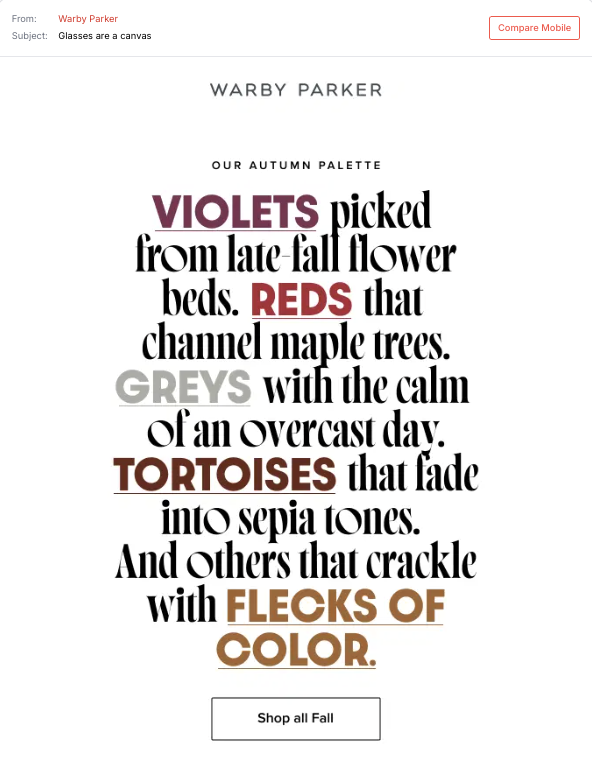
Warby Parker Text-Based Email
Source: Really Good Emails
Its fall email promises “deep violets,” “warm reds,” and “flecks of color,” without showing a single pair of glasses.
The click reveals whether the frames match the color story introduced in the email.
Create your own curiosity loop: reveal enough to tempt them, then save the answer for the click.
Turn your emails into part of the shopping experience
Fashion emails are blurring the line between inbox and online store.
So, before your next send, ask one question:
What action is the email encouraging besides getting the click?
Then make it possible for shoppers to take that action right there in the email. Help them discover products, tell you what they like, build a look, or find something made for them. Those interactions also create stronger signals for future personalization.
With SendX, you can segment audiences, personalize campaigns, and use customer preferences to make every send more relevant. That’s how you turn your emails from billboards into digital shop floors in 2026. Try SendX for free now.
FAQs
What makes a good fashion marketing email?
A good fashion marketing email gives customers a reason to do more than scroll. Think useful recommendations, interactive choices, strong creative, or an offer worth acting on.
How can fashion brands personalize their emails?
Use customer behavior, purchase history, preferences, and zero-party data to tailor products, content, and offers for different customers.
How often should fashion brands send marketing emails?
There’s no magic number. Send when you have something worth opening, then use engagement and unsubscribe data to find the frequency your audience actually wants.
