

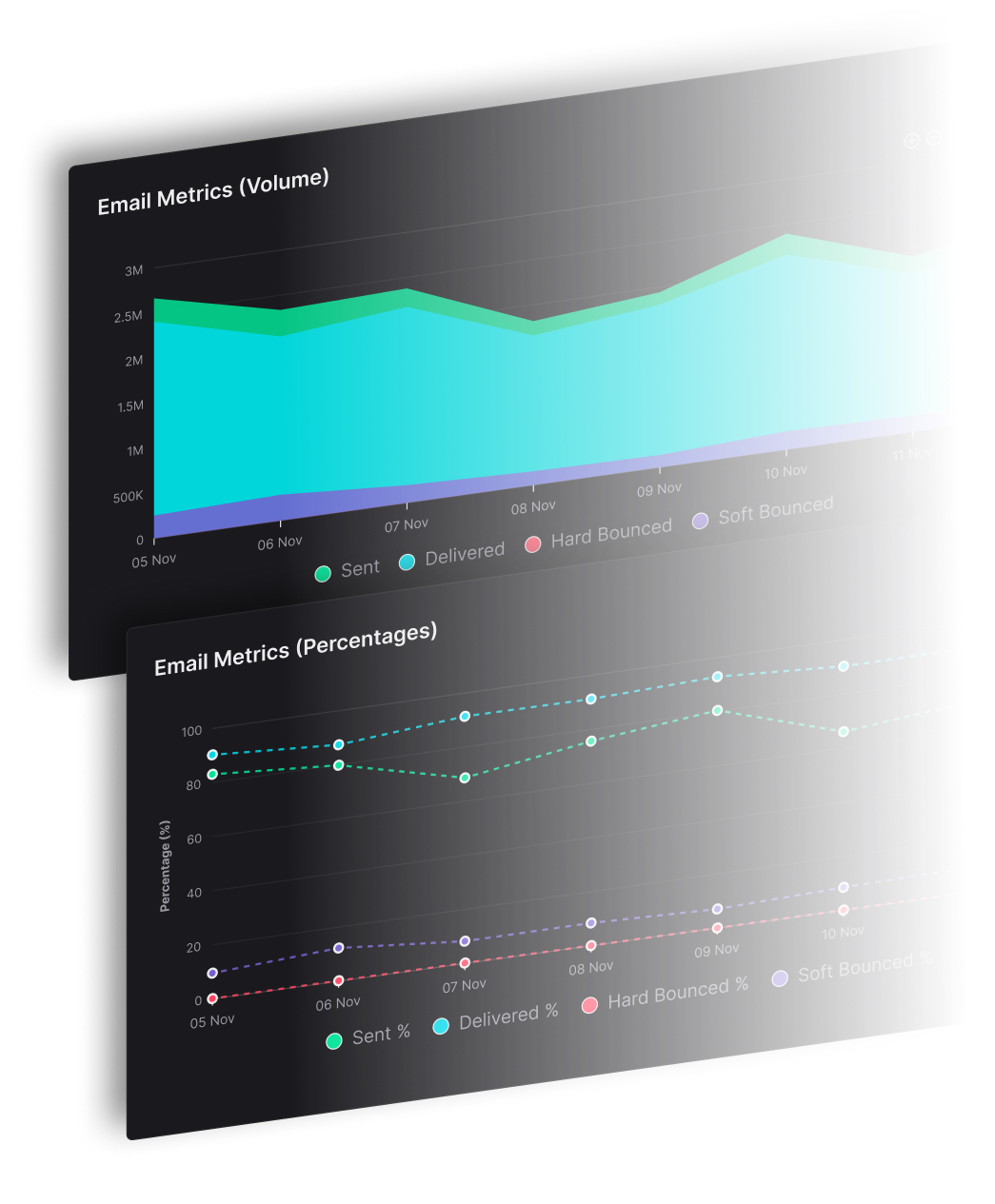


You hit send. The dashboard turns green. "Delivered," it says, and you move on to the next campaign.
But your email never reached anyone's inbox. It went to spam, sat in the Promotions tab, or got rejected at the door and bounced back to a server log nobody reads. The dashboard lied to you, and not because it's broken. It's measuring the wrong thing.
Quick answer: Email deliverability is the ability of an email to reach the recipient's primary inbox, not just the mail server, without being filtered to spam, promotions, or junk. It's different from delivery rate, which only confirms a server accepted the message. A good inbox placement rate in 2026 sits between 87% and 90%; anything below 80% is a problem that's actively costing you opens, clicks, and revenue. The global average is 87.2% (Validity, 2026 Email Deliverability Benchmark Report). For delivery and inbox placement targets by sending type and mailbox provider, see our guide to good email deliverability rate benchmarks.
Here's the part most guides skip: in 2026, roughly 1 in 6 marketing emails never reaches the inbox at all (Landbase, 2026). The rules changed permanently in 2024, the spam filters got a memory, and most senders are still flying blind. Let's fix that.
What actually changed in 2024 and 2025, and why the rules are now permanent
The biggest shift is that deliverability stopped being a set of polite suggestions. Google, Yahoo, and Microsoft turned their sender requirements into mechanical gates. Miss the requirements and your mail gets junked or rejected outright. There's no appeal queue and no benefit of the doubt. Microsoft enforces the same authentication floor that Gmail and Yahoo set in 2024, effective May 5, 2025 (dmarcian).
Think of it like airport security after a policy change. For years you could talk your way through with a smile. Now there's a scanner, and the scanner doesn't care how good your content is.
Here's the timeline, in plain English:
When | What happened | Source |
Feb 2024 | Gmail and Yahoo announce bulk-sender rules for 5,000+ messages/day: SPF + DKIM + DMARC, one-click unsubscribe, spam rate under 0.3% | |
June 2024 | Enforcement begins at Gmail and Yahoo | |
May 5, 2025 | Microsoft enforces SPF + DKIM + DMARC for Outlook, Hotmail, and Live (5,000+/day). Non-compliant mail is rejected outright, not routed to junk | |
Sept 2025 | Google deprecates Postmaster Tools v1, launches v2 with per-provider diagnostics | |
Nov 2025 | Google begins progressive re-enforcement. The 0.3% spam threshold moves from soft throttle to permanent reject |
The thing to internalize: these are no longer best practices you can get to next quarter. They're requirements your mail is checked against on every send. If you're still treating authentication as a one-time setup task you finished in 2023, the providers have already moved past you.
What are the four things that decide whether you land in the inbox?
Four levers determine inbox placement: authentication, list quality, content, and traffic shape. Authentication is the floor everyone has to clear. List quality is the most underestimated of the four. Fully authenticated domains earn 2.7x higher inbox placement than unauthenticated ones (Landbase, 2026), but authentication alone won't save a dirty list or a spiky send pattern. You need all four working together.
Authentication: the floor, not a differentiator
Globally, 88.99% of emails passed DMARC in Q1 2026, up from 86.42% a year earlier (TechnologyChecker.io, May 2026). If you're in the 11% that don't pass, you're not getting filtered. You're getting rejected. Setting up SPF, DKIM, and DMARC authentication (how to use email authentication protocols) is table stakes now, not a competitive edge. Among the Fortune 500, DMARC adoption sits at 93.8%, with 62.7% already at enforcement (EasyDMARC, 2025). One counterintuitive tip from the field: set your DKIM DNS record's TTL to 86,400 seconds (24 hours) at Microsoft. It reduces transient lookup failures that quietly tank otherwise-compliant mail.
List quality: the pillar everyone underestimates
A lot of programs that look like content problems are actually list problems. Keep hard bounces under 0.25% and soft bounces under 1% (bounce benchmarks), and hold complaint rates under the 0.1% Google Postmaster recommends (Google sender guidelines) at all times, never crossing 0.3% at Gmail. The average bounce rate runs around 2.33%, with under 2% considered acceptable and under 1% ideal (Marigold/Truly Inbox, 2026). The most common self-inflicted wound? Migrating to a new platform and re-importing every bounce you ever collected. Those addresses didn't get better in transit. Clean your list on import, and protect your email sender reputation (email sender reputation guide) by validating before the first send.
Content: the distinguishability test
The question a spam filter is really asking is simple: how is this email distinguishable from a scam? Image-only emails fail that test at Gmail. They're computationally expensive for AI filters to parse, and they pattern-match to low-quality sending. Always include meaningful text. Keep each image under 300KB and the total email under 1.5MB. Make the unsubscribe link visible, not 6-point gray on a white background. Mobile is now the single most common place people open email, at 41.6% of tracked opens versus 39.1% on webmail and 19.3% on desktop (Litmus Email Client Market Share, 2026), so optimize for a slow connection on a small screen, not your desktop preview.
Traffic shape: what most ESPs won't do for you
Consistent daily volume beats monthly spikes every time. Sending the same volume each day is the path of least resistance into the inbox; a quiet week followed by a million-email blast looks exactly like a compromised account. Per-provider throttling matters here, because every mailbox provider has its own tolerance for how fast you can send. When deferrals climb above 5% at any provider, that's an active problem, not a blip. As LB Blair, an email deliverability consultant, put it on a recent call: "If your deferrals are above five percent, for sure you've got a problem somewhere."
Why are your open rates lying to you?
Open rates are no longer a reliable deliverability signal, and treating them like one will hide problems until they're expensive. Apple's Mail Privacy Protection, which launched in 2021, pre-loads images and triggers fake opens. By 2025, an estimated 58% of recorded "opens" may be machine-generated, even as the average open rate climbed to 30.7% (Omnisend/Litmus, 2025). A rising open rate can mean Apple's bots are busy, not that humans are reading.
So watch per-provider signals instead. If you have zero opens and zero clicks at Hotmail on a given send, that's a near-certain sign your mail landed in spam there, regardless of what your aggregate number says. This is exactly the gap LB Blair sees publishers fall into:
“Email's gotten a lot more complicated. Just having your basic delivery rate, open rate, click rate, that does not cut it anymore. You really need to understand those metrics by mailbox provider so that you are maximizing your revenue opportunities.”
The metrics worth tracking now: per-provider inbox placement, deferral rate by provider (above 5% is a problem), complaint rate from Google Postmaster Tools, and hard and soft bounce rates broken out by provider. If your platform can't show you these email deliverability metrics (email deliverability metrics), that's a problem with the platform, not a reason to keep guessing.
What are spam filters doing differently in 2026?
AI spam filters now build a persistent memory of your domain, and that memory is harder to change than it used to be. When your reputation drops at Gmail, recovery is measurably slower than it was two or three years ago. A turnaround that once took four to six weeks can now stretch to three or four months. The filter forms a conclusion about your domain and defends it.
Here's how LB Blair described it, talking through what's changed for senders dealing with Gmail deliverability issues (Gmail deliverability issues):
“I am seeing turnarounds at Gmail become much more difficult. I'm not seeing domain reputations pick up like they used to... Folks in the industry have been saying Google Postmaster Tools domain reputation movements are much slower than they used to be. Extend those timeline expectations.”
That entrenchment creates two failure modes. The first is ignoring early warning signs, the small deferrals and per-provider open-rate dips, until the AI filter bakes them into its model of your domain. The second is getting your domain hijacked as an attack vector through an unsecured signup form. If a form has no CAPTCHA or bot protection, bots will stuff it with junk addresses and torch your reputation on your behalf.
The practical takeaway is encouraging, not alarming: catch it early and the cost is nearly zero. A deferral spotted at 100 messages is a five-minute fix. The same pattern left alone for four months is a quarter of recovery work. Early visibility is the entire game.
What does a spam-folder email actually cost you?
A spam-folder email costs you the full value of the click you would have earned, multiplied across every message that misses the inbox. LB Blair offers a clean formula: spam-folder revenue loss = (percentage of mail landing in spam) × (your click rate) × (the value of a click). It turns an invisible problem into a number you can put on a slide.
Here's the example he walked through:
“If you have a hundred thousand emails landing in spam and a two percent click rate and a click is worth two dollars, that's still gonna be like four thousand dollars per send that you're out.”
For newsletter publishers on an ad model, every email in spam is a sponsor impression and a sponsor click that never happens. You paid to acquire that subscriber. You paid your ESP to send to them. You paid to produce the issue. All of it evaporates when the message lands somewhere nobody looks. As LB put it, you're in a padded room: "You're literally screaming at them from the spam folder where they can't hear you."
It gets worse when reputation falls far enough to affect the whole domain. Password resets, one-time passcodes, and support emails start failing too. "People really don't understand the devastation that bad deliverability can cause until they're in the middle of it," LB said. The point isn't to scare you. It's that the downside is concrete and avoidable, and the math gives you a reason to act before it compounds. If you're already seeing symptoms, start with these common email deliverability issues (email deliverability issues) and work backward.
What's the practical deliverability checklist for 2026?
The 2026 checklist breaks into four areas: authentication, list hygiene, content, and infrastructure. Do the authentication items first, because nothing else matters if your mail can't clear the gate. The full list below is what to do and why it matters right now, not a generic best-practices dump. For a deeper walkthrough, the email deliverability best practices guide (email deliverability best practices) expands each item.
Authentication (non-negotiable):
SPF record configured and covering every sending source you use.
DKIM set up and aligned with your From domain.
DMARC starting at p=none with an RUA reporting address, moving to quarantine or reject after 90 days.
DKIM DNS TTL set to 86,400 seconds at Microsoft to cut transient lookup failures.
One-click unsubscribe header enabled.
List hygiene:
Hard bounce rate below 0.25%, soft bounce below 1%.
Complaint rate below 0.1%, with Google Postmaster Tools as your source of truth.
New list? Validate before the first send. Migrating? Don't re-import bounces from the old platform.
Touch every contact at least once every 30 days so mailbox-hygiene cleanups don't catch you off guard.
Content:
Meaningful text in every email, never images alone.
Each image under 300KB, total email under 1.5MB.
A plain-text version always present.
An unsubscribe link a human can actually find.
Run a seed test with a tool before any large send.
Infrastructure:
Google Postmaster Tools configured and checked weekly.
Per-provider open and bounce rates visible in your dashboard. If they aren't, escalate to your ESP.
Deferral monitoring, with anything above 5% at a provider triggering an immediate look.
Warm up new IPs and domains. Never send high volume from day one.
If you want to confirm your setup before you trust it, run it through the right tools to test your email deliverability (best tools to test deliverability) first.
Where SendX and SendPost fit
Most of what LB Blair describes as essential, the per-provider inbox placement, the bounce codes, the deferral rates by mailbox provider, is exactly what the typical ESP doesn't expose. That's the visibility gap that turns a five-minute fix into a four-month recovery. SendPost, the developer-facing sending engine behind SendX, is built to surface that per-provider data: which providers are deferring you, where you're blocked, and the delisting links to fix it. You can't manage a risk you can't see, and seeing it is the entire point.
Deliverability in 2026 isn't a setup task you finish once. It's an operating discipline you run every week. The senders who treat it that way reach the inbox. The ones who don't keep screaming into the padded room.
Ready to see your real per-provider numbers instead of a green "delivered" light? Try SendX free (Try SendX free), or start by learning how to maintain high email deliverability (maintain high email deliverability) over the long haul.
FAQs
What is email deliverability?
Email deliverability is the ability of an email to reach the recipient's primary inbox rather than being filtered to spam or junk. It's distinct from delivery rate, which only measures whether the mail server accepted the message. Good deliverability means the email lands where the recipient can actually see it.
What is a good inbox placement rate in 2026?
The global average is 87.2% (Validity, 2026 Benchmark Report). High-performing senders hit 95% or better (EmailToolTester). Anything below 80% indicates a deliverability problem that's actively costing you opens and revenue. Gmail performs better than Microsoft and Outlook, which sits around 77% (Validity), which makes Outlook the hardest major inbox to reach.
How do Google's 2024 sender requirements affect deliverability?
Google's bulk-sender rules, effective June 2024 for senders of 5,000+ emails per day, require SPF, DKIM, and DMARC authentication, a one-click unsubscribe link, and a spam complaint rate below 0.3% (Google sender guidelines). Violating any of these sends your mail to spam or rejects it outright. In November 2025, Google moved the 0.3% threshold from a soft throttle to a permanent reject.
What happens if your spam complaint rate goes above 0.3%?
Gmail begins rejecting your mail outright rather than filtering it to spam, bouncing it entirely. The threshold moved to hard enforcement in November 2025 (LeadEx). The safe operating range is below 0.1%. If you're above that, investigate your list quality and send cadence before the next campaign.
How long does it take to recover Gmail domain reputation in 2026?
Longer than it used to. Industry practitioners reported in mid-2026 that Google Postmaster Tools domain reputation movements are noticeably slower than in prior years. Recovery that once took four to six weeks may now take three to four months. The lesson is to catch problems early and not let bad signals entrench in Gmail's AI filter.
Do Microsoft's email requirements match Google's?
Yes, as of May 5, 2025. Microsoft now requires SPF, DKIM, and DMARC for bulk senders to Outlook, Hotmail, and Live (5,000+ messages per day). Non-compliant mail is rejected outright rather than routed to junk (dmarcian, 2025). Microsoft was reportedly enforcing DMARC failures even before its formal announcement.
Sources: Validity 2026 Benchmark Report (Validity), EmailToolTester (EmailToolTester), Litmus State of Email (Litmus), Omnisend (Omnisend), Statista (Statista), Google sender guidelines (Google), dmarcian (dmarcian), TechnologyChecker.io (TechnologyChecker.io), EasyDMARC via DMARCguard (DMARCguard). Thought-leader commentary from LB Blair, email deliverability consultant (SendX call, June 2026).
