



SendPost Powers SendX to 95-98% Delivery
Discover how an ESP went from no control or visibility into email delivery to real-time visibility, AI-powered throttling, and automated warmups with SendPost's email sending infrastructure built specifically for ESPs
Delivery Rate Improvement
See how SendPost optimizes SendX email delivery
Before SendPost
70%
Average delivery rate
With SendPost
98%
Optimized delivery rate
Challenge
SendX, an ESP for 3,000+ clients across the globe, sent 100M+ emails a month. But legacy email delivery tools slowed growth because:
There was no data or logs when delivery rates dropped
Manual IP & domain warm-ups took weeks
Compliant senders faced account bans randomly
Infra bills kept growing without better delivery
The team was stuck fixing issues blindly, and the workload was growing fast enough to balloon the delivery team.
Results
Switching to SendPost transformed SendX's delivery operations from reactive to reliable.
Delivery success rose to 95–98%, even in tough verticals like gaming and crypto
Escalations that once took hours were resolved in minutes
Automated warm-ups cut onboarding time by 80%
Engineers reclaimed dozens of hours weekly, focusing back on product innovation
SendX scaled from 100M to 300M+ monthly sends — with no added headcount
About SendX

SendX is a full-stack email marketing and automation platform serving 3,000+ businesses (iGaming, casinos, fintech, eCommerce, and more). Running hundreds of millions of sends monthly, SendX faces the same challenges every ESP does: no visibility into email delivery issues, no control over key aspects like throttling, and IP warm-ups.
Email Service Provider
Full-stack email marketing and automation platform
300M+ Emails Sent Every Month
High-volume campaigns at scale
3,000+ Global Customers
Trusted by businesses worldwide
Built to Manage Diverse Sender Profiles at Scale
From iGaming to fintech and eCommerce
The Challenges
Before SendPost, SendX faced the same infrastructure limitations that plague most ESPs—limited visibility, manual processes, and unpredictable deliverability.
1. No Visibility Into Why Emails Failed
When delivery rates dropped, legacy MTAs like SendGrid and SES don't give any data, such as domain-level logs, ISP responses, or error granularity, to find the root cause.
We were spending hours trying to answer one simple question — why didn't this email land? But there was no data, no logs, nothing. It felt like driving blind in a thunderstorm with our customers demanding answers from the backseat.
— Rajesh Pandi, Delivery Engineer at SendX
2. Random Bans and Compliance Blackouts
Even clean, opt-in clients in gaming and crypto got suspended without warning. Every high-volume account felt like a compliance risk.
3. Manual, Error-Prone Warm-Ups
Every new sender meant weeks of hand-tuned IP ramping and pacing. It wasn't uncommon for warm-up timelines to stretch to 60 days, with no guarantee of success.
We were literally babysitting IPs day and night. Adjusting sending speeds manually, watching volumes inch up, hoping nothing broke. It wasn't scalable at all.
— Varun, Co-founder of SendX
4. Infrastructure Built for Developers, Not ESPs
Legacy MTAs lacked basic ESP controls like sub-account visibility, IP pool management, or ISP-specific throttling. Scaling meant patching scripts that constantly broke.
5. Team Burnout and Scaling Pressure
The engineering and delivery teams spent their days chasing problems instead of improving the product. It wasn't sustainable — either headcount would balloon, or delivery would implode.
6. High Costs with Low Confidence
Despite spending tens of thousands of $$$$ a month for premium support on tools like SendGrid and Mailgun, SendX still couldn't guarantee the delivery of emails.
The Solution
After years of fighting black-box systems and unreliable delivery, the SendX team hit a breaking point and built their own email delivery infrastructure.
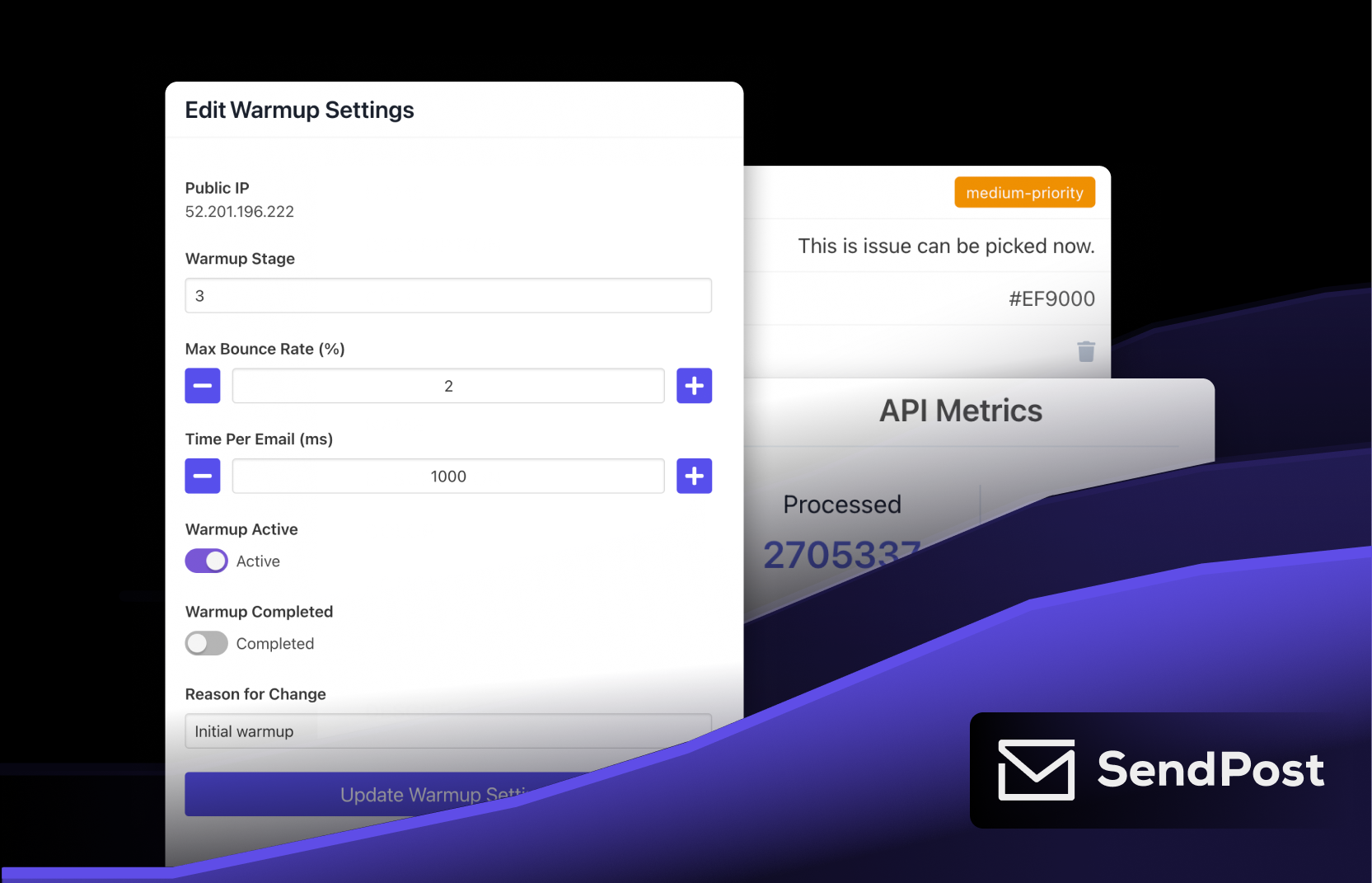
After years of fighting black-box systems and unreliable delivery, the SendX team hit a breaking point.
We realized we were optimizing around the limits of other people's infrastructure instead of solving the real problem.
— Varun, CTO, SendX
That's when Varun and the SendX engineering team decided to build their own email delivery infrastructure that'll give them full control and visibility into email sending. That product became SendPost.
Built for ESP Realities
SendPost was purpose-built for multi-tenant ESPs managing high-volume, complex email delivery. It gives teams full visibility, control, and automation across their entire sending stack:
- Create and manage sub-accounts programmatically
- Isolate IP pools by sender reputation
- Apply custom throttling and routing per ISP
- Centralize MTA rule management and monitoring
Deep Visibility Across Every Layer
SendPost gives ESPs complete transparency into what's happening inside their sending pipeline. You can see:
- Delivery health by IP, domain, or mailbox provider (Gmail, Microsoft, Yahoo, etc.)
- Live ISP response data and SMTP error aggregation
- Blacklist status and reputation trends per IP pool
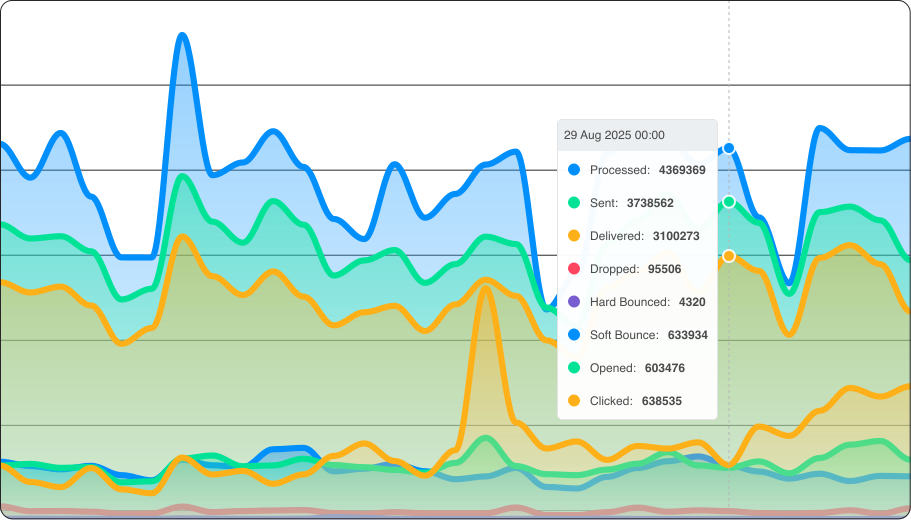
I've worked with SendGrid, Mailgun, SparkPost — none of them come close to this level of visibility. SendPost finally gives email deliverability professionals the data we've been begging for.
— LoriBeth Blair, Email Deliverability Consultant
Automated IP & Domain Warm-Ups
IP and domain warm-ups auto-adjust in real time based on performance, while built-in compliance intelligence tracks domain reputation, Postmaster data, and sender quality signals automatically.
Compliance and Sender Intelligence
Every domain connected to SendPost is automatically analyzed for:
- Domain age and reputation
- Website traffic and engagement
- Postmaster and SNDS feedback integration
These data points help ESPs validate legitimate senders and flag spammy signups.
Long-term Data Access
Raw event data is stored for up to three years, fully searchable by API. You can run historical analysis, correlate incidents, and identify long-term trends.
Fully API-driven
Every capability — monitoring, routing, alerts, warm-ups, and reputation management — is API-driven, letting ESPs automate onboarding, responses, and diagnostics end-to-end.
I tell people all the time — this is the platform I wish had existed ten years ago. If SendPost had been around then, half the deliverability crises I've managed wouldn't have happened.
— LoriBeth Blair, Email Deliverability Consultant
The Results
With SendPost as its email delivery engine, SendX transformed from a team fighting fires to a lean, scalable operation delivering hundreds of millions of emails with enterprise-grade reliability.
95–98% Delivery Rates for 300M+ Emails
SendX now sends over 300M emails each month with 95–98% delivery rates — even across challenging verticals like gaming, casinos, and crypto.
90–95% Warm-Up Success Rate
Automated IP and domain warm-ups cut 30–60 hours of manual work per sender and removed all onboarding guesswork.
3X Lower Infrastructure Cost
SendX now achieves enterprise-grade email sending at a fraction of what legacy MTAs used to cost.
0 Headcount Increase
Despite handling ~300M emails monthly, SendX maintains its original lean team. It relies on automation and transparent diagnostics to be on the road to scale to billions of emails per month.
Faster Root-Cause Diagnosis
Every bounce, block, or delay is traceable to a specific ISP or IP. This helps solve the problem quickly.
We can finally answer the 'why' behind every deliverability dip instead of speculating or waiting for someone else to tell us.
— Varun, CTO of SendX
Engineering Focus Realigned
With infrastructure stability ensured, engineers reclaimed time for product innovation and analytics, rather than spending it on delivery maintenance.
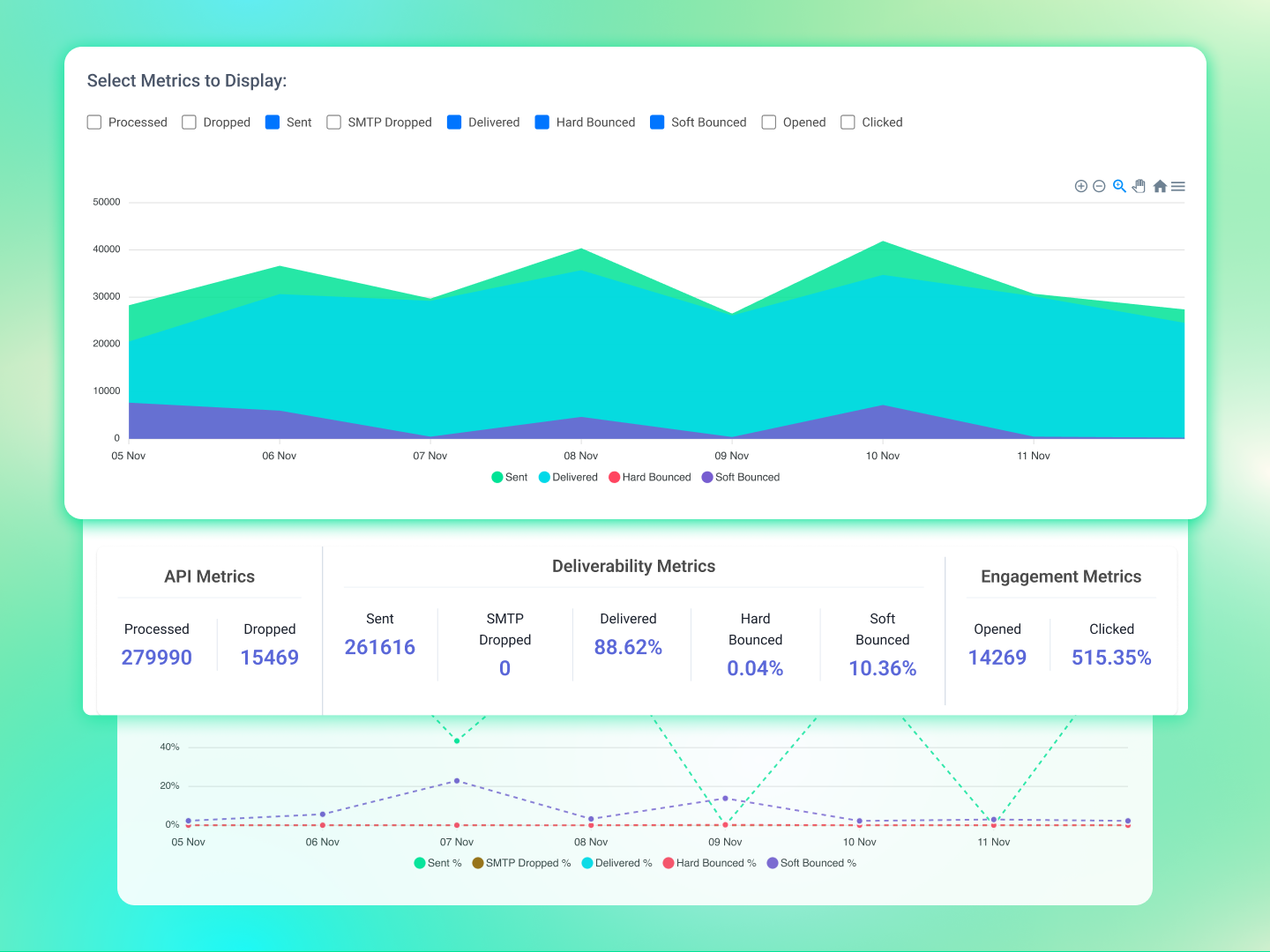
Our best people are back to building features, not chasing deliverability ghosts. That's the biggest cultural win for us.
— Varun, CTO of SendX
Before vs. After SendPost
Here's what changed when SendX moved to SendPost's infrastructure. Same team size. 10X volume increase. Dramatically better results.
| Metric | Before SendPost | After SendPost |
|---|---|---|
| Delivery rate | 70–85% | 95–98% |
| Mean time to diagnose (MTTD) | ~2–6 hours | <15 minutes |
| Warm-up success rate | ~60–70% (manual) | 90–95% (auto) |
| Time to staging parity | 1–3 weeks typical | <48 hours |
| IP/domain warm-up effort | High; manual pacing | Automated; set-and-adapt |
| Per-ISP throttling/backoff | Limited/one-size | Custom per ISP |
| Sub-account visibility | Surface-level | Parent→child drill-down |
| Raw event retention | No visibility | Up to 3 years |
| Blacklist/reputation monitoring | Fragmented tools | Integrated |
| Cost per 1M emails (infra) | Expensive | 3X reduction in cost |
| Team headcount (deliverability) | 5 | 5 |
Same team size • 10x volume increase • 95-98% delivery rates
Repeatable Beyond SendX
SendPost was born from SendX's internal delivery struggles, but it was never meant to stay internal.
The same infrastructure is now available as a repeatable, production-ready system that any ESP can deploy without struggling with a legacy email delivery tool.
Talk to us and see exactly what's happening across your sending pipeline.
Schedule a demo